Tower Bridge is one of London’s most famous landmarks. With it’s unique design and fascinating history it is a must see on any visit to London. Here are some interesting facts about Tower Bridge you might not of known.
Tower Bridge is one of my favourite spots in London. Over the years I’ve walked, driven, bussed and ran over it for what feels a million times.
It’s one of the high points of the London Marathon, the crowds lining both sides of the bridge so deep you can’t even see the river, the noise deafening.
At the end of 2020, it took centre stage in London’s surprise New Year’s Eve celebrations. It really is one of London’s iconic landmarks.

Yet for some reason I have never thought of going inside. I didn’t even realise you can walk across the top of Tower Bridge via the upper walkaways. A classic case of not appreciating what is on your doorstep.
So, I took advantage of the lack of tourists in London in the summer of 2020 and decided to visit some of London’s top attractions without the crowds. A once in a lifetime (hopefully) opportunity.
Tower Bridge was top of my list.
As well as being able to enjoy a panoramic view of London you can go inside and discover the history of the bridge, how it was built and powered and lots of interesting (and some surprising) facts.
Tower Bridge facts
It’s not London Bridge
Let’s get this out of the way first. While Tower Bridge is the most recognisable bridge in London, if not the world, it seems to often get confused with London Bridge. When I worked nearby I almost lost count of the times I was asked for directions to London Bridge and then realised they meant Tower Bridge.
London Bridge is the next bridge heading west along the river. What it lacks in looks (and it’s pretty plain in comparison) it makes up for in history. The first London bridge was built in Roman times and it has been replaced several times over the centuries.

40,000 people cross the bridge each day
Linking the south side of the River Thames to the City of London, Tower Bridge is a vital crossing point. Around 40,000 people cross the bridge each day either by foot, car, motorcycle or bike.
The bridge lifts around 800 times a year
Most boats that sail along the River Thames these days are tourist boats, the tall cargo ships heading to riverside warehouses by London Bridge are long gone. However, the bridge still regularly opens to let vessels through.
Visit the official website for details of when the Tower Bridge lift times.
Related post | Things to do around Tower Bridge
Building Tower Bridge: interesting facts
A public competition was held to find a design for the bridge
With more and more people flocking to London and increasing commercial development a new river crossing was needed, downstream of London Bridge to ease congestion.
However, the City of London had a challenge. A traditional bridge was not suitable as it would disrupt river traffic and cut off access to the Pool of London, once the busiest port in the world.
In 1876, they decided to hold a public competition to generate ideas. Over 50 designs were submitted but none was used. Some of the entries on display at Tower Bridge today.
Eventually in 1884 a design by Sir Horace Jones, the City Architect, and John Wolfe Barry was approved.
The architect that designed the bridge also designed three of London’s famous markets
Sir Horace Jones also designed three of London’s famous markets, all of which survive today even if they are not used as their original purpose.
- Leadenhall Market is a popular spot in the city and you’ll often find city workers there having a drink after work. You might also recognise it from the Harry Potter films
- Old Billingsgate, once home to the world famous fish market (now housed down the river in Docklands), it is now an event space holding exhibitions, balls and dinners.
- Smithfield Market, still a working wholesale market and the future home to the Museum of London (opening 2024)
It is a combination of bascule bridge and a suspension bridge
Tower Bridge is one of the most famous bascule bridges in the world. Translated from French as seesaw, this describes how the two sides of Tower Bridge open.
The two side spans are suspension bridges and are anchored from the river bank to the towers.
Building the Bridge took eight years
It was no easy task to build Tower Bridge. 432 construction workers laboured each day between 1886 and 1894 to construct it.
Opening Tower Bridge was powered by steam until 1976
After a port was opened closer to the sea, fewer ships came along this section of the River Thames. With the Bridge not opening so much, steam became an inefficient way to power rising the bascules.
In addition, new rules around emissions and clean air were put in place too, so it was decided to install a new electro-hydraulic system to open the Bridge.
The switch to electricity took place in 1976. The original (now restored) steam engines are still on display in the Engine room.

Fun facts about Tower Bridge
Despite being such an iconic part of the London skyline, there are still lots of surprises in the history of Tower Bridge.
Here are some Tower Bridge fun facts that most Londoners probably don’t even know.
It was originally a chocolate brown colour
Having always known the bridge as white and blue with a dash of red I found this hard to believe. It’s true and when you go inside Tower Bridge you can still see the original (pretty dull) colour scheme.
It was painted red, white and blue to celebrate the Queen’s Silver Jubilee in 1977 and given a new lick of paint in 2009.

It takes 5,821 gallons of paint to cover it.
So you can see why they don’t repaint it very often.
Between the towers there is a glass walkway
Not for the faint hearted but while crossing the Bridge via the upper walkways you can get a unique view of London.
Part of the walkway has been replaced with an 11 meter long, 1.8 meter wide glass floor. At 42 meters above the River Thames it offers a one of a kind view of London. If you can bear to look down!
Keep an eye out for the red London buses and black taxis. All looking like toy cars from up there.
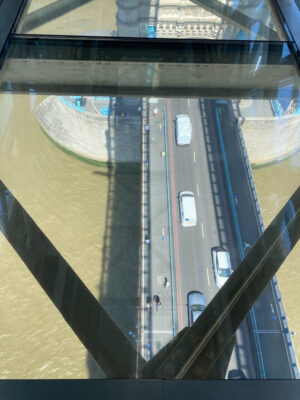
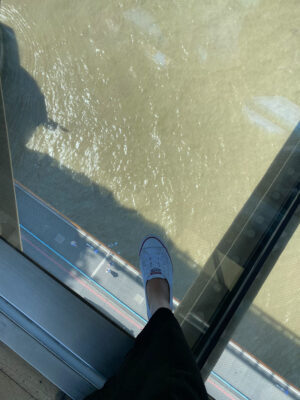
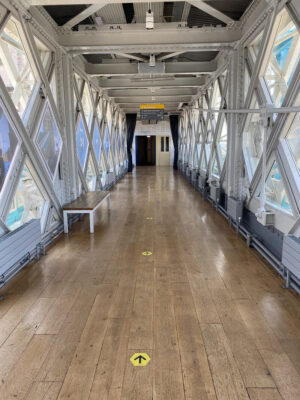
The two upper Tower Bridge walkways were designed to allow people to cross the road when the bridge was raised. However, the thought of climbing a few hundred steps up and down again the other side didn’t seem to appeal to many people. The walkways were hardly used and were closed in 1910.
They were reopened in 1982 and along with the dazzling glass floor are a highlight of a visit inside Tower Bridge.
Ships have right of way
If you have a boat you’ll be pleased to know that vessels have right of way. River traffic takes priority. This applies to everyone, even if you are a world leader. In 1997, the then American President, Bill Clinton’s motorcade was split by the opening bridge. The rising bascules wait for no one.
Originally, Bridge staff looked out for ships heading towards them and opened the bascules once the road was cleared. These days you need to book a Bridge lift at least 24 hours in advance.
Planes have flown through the bridge
In 1912, just nine years after the Wright Brothers flight, Frank McClean and his seaplane became the first to fly through the gap between the road and the walkways. In 1919, after Sidney Pickles passed through the Bridge at 120mph, flying under it was outlawed.
However, that didn’t stop other pilots giving it a go. At least four more have tried over the years.
Tower Bridge took centre stage in the 2012 Summer Olympics
To celebrate the London 2012 Summer Olympics, the Olympic Rings were suspended from the Bridge.
Tower Bridge also had a starring role in the Opening Ceremony. Two helicopters flew through the gap between the upper walkway and road carrying a stunt double of the Queen.
They then continued onto the Olympic Stadium in Stratford where the Queen made a memorable entrance by parachuting out of the helicopter.
David Beckham (in a suit on speedboat no less – definitely a highlight of London 2012!) travelled underneath the Bridge delivering the Olympic flame used to light cauldron in the stadium.
A bus once jumped over the bridge (for real)
This is definitely one of those stories that you can’t quite believe (especially if you’ve ever travelled over Tower Bridge in a bus) but actually did happen. And not in a film either.
As the number 78 bus, from Dulwich to Shoreditch drove over the bridge, the driver, Albert Gunter noticed the road in front of him disappearing. Realising the bridge was opening, he hit the accelerator and jumped the rising bascule landing safely on the north side which had not yet begun to open.
The Spice Girls also jumped the bridge (in a film, kind of)
While the above story sounds like something out of a film, it’s not. However, the Spice Girls jumped Tower Bridge in their Spice Bus in their film, Spice World. Rushing to get to their concert at the Royal Albert Hall, the bridge starts to lift and Victoria jumps their double-decker bus over the gap.
Be the envy of your mates by holding your wedding or birthday party inside the bridge
Believe it or not you can hire out event spaces in the bridge for your party including the panoramic walkways and engine rooms.
You can find more information about Tower Bridge on their website.
Tips for visiting Tower Bridge
Getting there
Tube: The nearest tube stations to Tower Bridge are Tower Hill (Circle and District Lines) and London Bridge (Northern and Jubilee lines)
Train: The bride is a short walk from Fenchurch Street and London Bridge stations.
DLR: Tower Gatway
Riverboat: Boats stop at Tower Pier, St Katherine’s Pier on the north side and London Bridge cit pier on the south side.
Best views of Tower Bridge
If you are looking for the best spots to get a photo of Tower Bridge or view the bascules being raised
Northside of the River Thames
- Tower of London – outside on the path along the Thames Path
- Old Billingsgate, outside on the river bank
- London Bridge – a short distance away but you will get a front on view
- St Katherine’s dock – outside the front of the Tower Hotel. Look for the sundial and the girl playing with a dolphin statue
Southside of the River Thames
- Potters Field/City Hall – long path from the bridge heading west along the river.
- Butler’s Wharf
Book your ticket in advance
For more information about Tower Bridge and to book a ticket, head over to their website.
Given how quiet London was when I visited, I was able to just turn up, get a ticket and walk straight in. However, it is advisable to book a ticket in advance so you don’t miss out.
You might also enjoy
- Fabulous things to do near Tower Bridge
- Uncovering London’s ancient secrets
- Discovering Roman London
- Things to do in London in Summer