Discover what is it is like exploring Japan as part of a small group tour with Inside Japan.
Thinking of visiting Japan and considering a group tour but are not quite sure if it is for you?
I was in that position a few years ago and eventually decided I’d give it a go. So, I thought I’d put together a review of the tour I took to help you decide if it is the style of travel for you.
Exploring Japan on a small group tour
It’s long been a dream of mine to visit Japan so back in 2019 I decided it was time to make that dream a reality.
As I knew I’d have to travel solo I decided to take a group tour. I thought it would take away some of the worries about not speaking the language and give me some company. While I wanted to see Japan with others, I didn’t want to be in a large group of people being ferried around with only a few minutes at each place.
After a LOT of research and reading some Inside Japan reviews I decided they were the best option. Although that wasn’t the end of it. They have so many tours with amazing itineraries, it was just as hard to choose which one to book.
Eventually, I decided on Spring Elegance. It covered almost all the places I wanted to visit, offered the opportunity to meet a Makio (trainee Geisha) and included tickets to the spring dance performances. Both of which were things I wanted to do in Japan.
I was due to go in March 2020 but we all know what happened there. I eventually made in there in March 2023 so I thought I’d share my experience of visiting during the first cherry blossom seasons open to tourist in two years.

Benefits of a Small Group Tour
Before I share what the tour was like, I thought it was worth having a look at the benefits of a group tour.
I usually travel independently and had never really considered a group tour before. Now I’ve taken the plunge, I can see the attraction of this type of trip.
Some of the benefits of a group tour include
- It is a convenient way to travel. All the arrangements such as booking accommodation and transport are booked for you, leaving you to focus on enjoying the trip. They are a hassle-free way to travel
- The pre-planned itinerary will ensure you see all the highlights of the destination you are visiting and perhaps some places you may not have considered had you been travelling independently.
- An expert guide will travel with you, taking care of some of the on-the-ground logistics, sharing information about the destination you are travelling around and ensuring you have a great time
- You can share the experience with others
- If you are travelling solo, they give you some company and like-minded people to travel with.
A little bit about Inside Japan
Inside Japan specialise in tours to Japan (as you may have guessed). They offer a range of small group tours to suit pretty much every budget and interest. If you prefer to travel more independently, they can also put together a self guided tour for you.
Spring Elegance
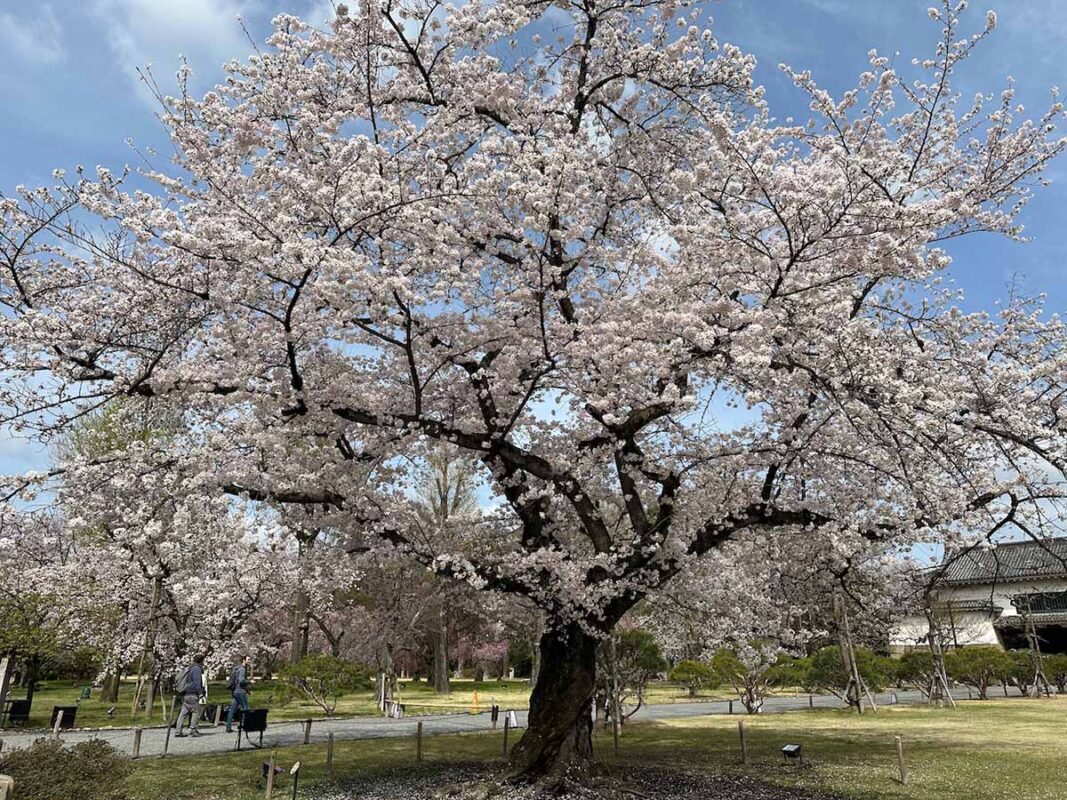
This tour runs a few times each spring. While you travel to all the classic sightseeing places in Japan, the tour is very much focused on celebrating the spring (hence the tour name!).
Spring is a great time to head to Japan as you’ll have the opportunity to see the cherry blossom and all the traditions and festivals that accompany this special time of year.
What’s included on the tour
- Airport transfers
- Accommodation
- Breakfast (every day)
- Four meals
- Luggage forwarding
- Shared portable wifi
- Private coaches for sightseeing in Tokyo (half day) and Kyoto (full day)
- Private coach transfer between Takayama and Kanazawa
You also get some attractions and experiences included
- IC transport card with credit of 2,500 yen (very handy to explore Tokyo with before the tour starts)
- Entrance to Hamarikyu Gardens (Tokyo)
- Entrance to Hida no Sato folk village (Takayama)
- Private afternoon tea with a Maiko
- Tickets for the Geisha spring dances
- Entrance to the Hakone Open Air Museum
While the cost of the tour may seem expensive, at first glance, you do actually get a lot included. Overall, I think it works out pretty cost-effective. Plus you have the services of a guide, which after my experience I think is priceless.
Getting to Tokyo
I’m in the UK so I flew from London Heathrow to Tokyo Haneda. I was a bit daft and left it a bit late to book flights.
Being my third attempt at this trip I guess I was a little skeptical it was actually going to happen. So, there wasn’t a lot of choice of reasonably priced flights still available. I ended up going with Japan Airlines, thought I might as well start the Japanese experience from the beginning! They were great and the service was fabulous.
Though as a Brit, I did miss a cup of tea!
Tip | Book your flight as soon as you can. Inside Japan can book flights for you. This does take some of the hassle out of finding flights. Also if there are any issues, they will be on hand to help.
Arriving in Japan
This was my first big trip post the pandemic (and being diagnosed with cancer). So, that combined with worries about the language barrier I was a little nervous about how things would go when arriving in Japan.
I needn’t have been though. It was one of the smoothest and most organised arrivals in any country I have visited.

Stepping off the plane, you are greeted by a line of people, every two meters or so, welcoming you to Japan and directing you where to go. This went on pretty much the whole way to quarantine and immigration.
Everyone was very friendly and really helpful despite the language barrier. It was the same in baggage claim and customs. There were plenty of people around to help.
The tour includes a taxi shuttle to the hotel and this was another thing I was a little worried about. Again, it was no problem. I found the person from the transfer company easily and after a short wait for a fellow passenger (on another tour), he showed us to our taxi.
So all my worries were unfounded.
I arrived at the hotel mid-morning. An early-check in isn’t a thing in Japan so I left my cases and headed out for my first experience of Tokyo.
Well, kind of.
The hotel staff directed me to a nearby Starbucks so I could get a drink. So, perhaps not the first Japanese experience you might expect! However, it was a good chance to catch my breath and set up my phone for the trip.
I bought an Airalo data e-sim so I could use the maps and translations apps if needed and keep in touch with family and friends at home. It worked really well throughout the trip.
Tip | If you are not keen on wandering around Tokyo before being able to check into your hotel or would prefer to be able to get into your hotel room as soon as you arrive, book a flight that lands in Tokyo from lunchtime onwards.
Pre Tour
It is recommended you arrive a night or two before the tour starts.
I decided on two nights before as I wanted to make sure I was fully recovered from the long flight and could hit the ground running once the tour started. Arriving early also has the advantage of giving you a bit more time to explore Tokyo.
The tour guide also arrives two nights before as well. So, although this time isn’t officially part of the tour, they are available to help you navigate Tokyo and provide suggestions of things to do or places to eat.
Spring Elegance Itinerary
One of the plus points of a group tour with Inside Japan is that they are fairly flexible. Of course there is an itinerary to follow, however if you wish you do something else on a particular day you can.
Our guide (and I’m sure all their guides) also do their best to make sure any special interest you may have is covered. So, although I’ve detailed my trip below, keep in mind that all trips are probably a little different depending on the interests of the group.
Day 1 – Tokyo
The tour starts with dinner on the first evening. This is a great way to get to know your fellow travel companions for the next few weeks in a relaxed setting.
Before that, you have the day to explore. As we were staying near (ish) the Tokyo Skytree myself and a couple of other early arrivals headed out to get an aerial view of Tokyo.
At 634m tall, the Skytree is the tallest free-standing broadcasting tower in the world.
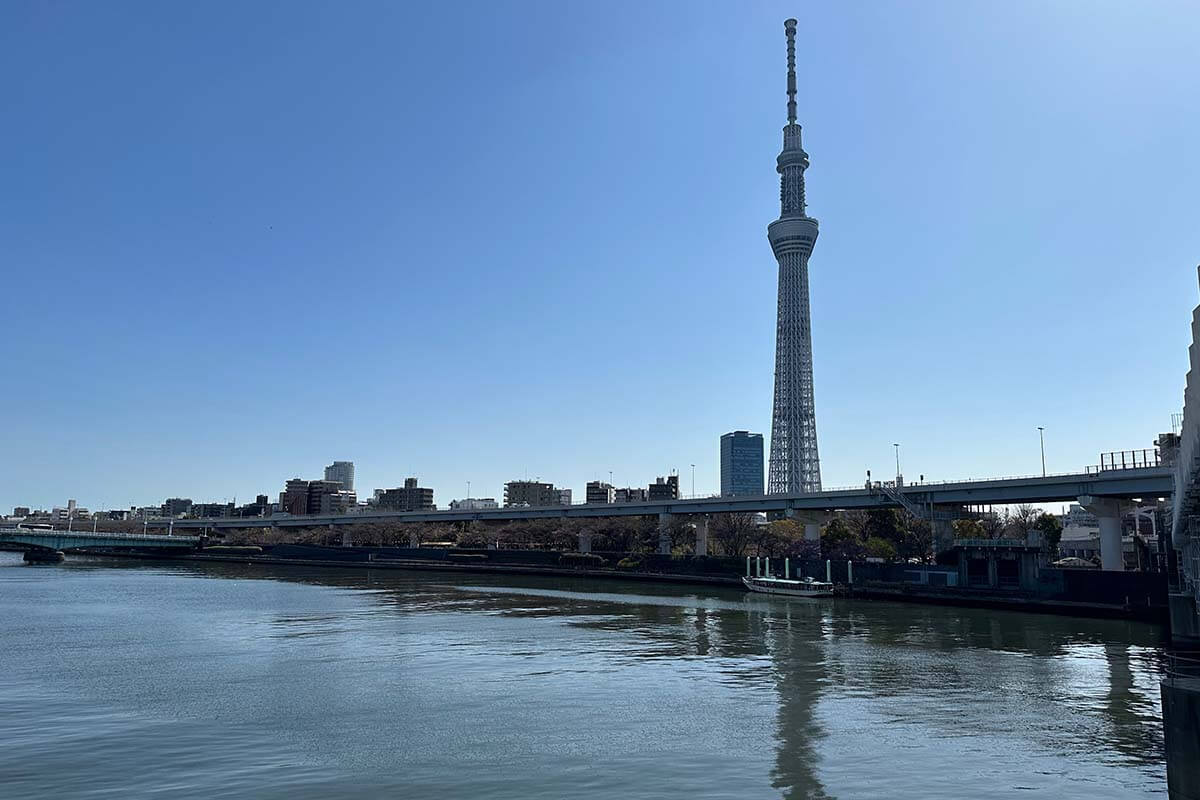
With amazing panoramic views of the city, it is one of Tokyo’s most popular tourist attractions. It didn’t take us long to discover that!
In hindsight we probably should have booked a timed ticket in advance as by the time we got there, a long queue had already formed and we could only get tickets for an hour later and only for the first level.
It was definitely an introduction to how busy places can be in Japan.
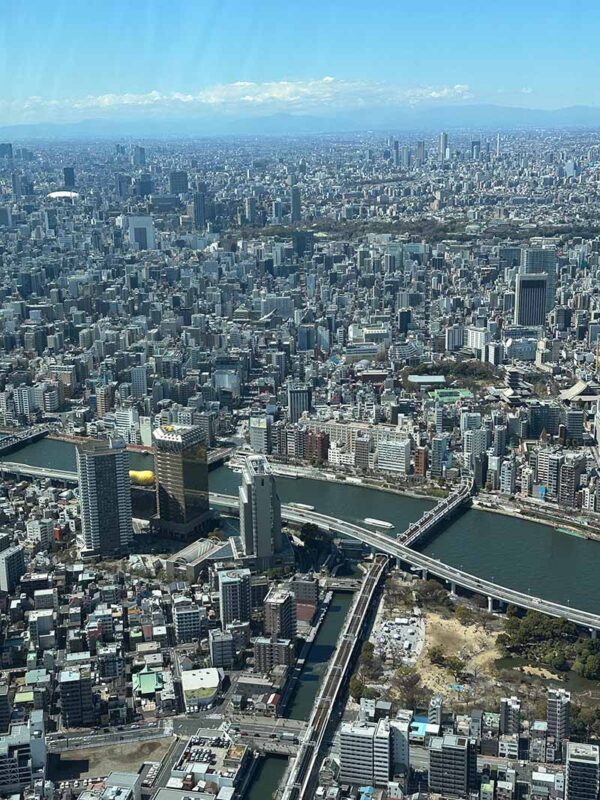
As you might expect, despite the huge numbers of people it was well organised and eventually, we made our way to the elevators up to the first observation deck. Despite being 350 meters above street level, it takes mere seconds to get there.
Being that high up, you can start to see the scale of Tokyo. It seems to go on as far as the eye can see. Something you can’t comprehend at ground level.
Tip | If you want to visit the Skytree book timed tickets in advance. It will save you time as you won’t have to queue to buy tickets. So you’ll have more time to explore the Skytree complex.
During the afternoon we headed to Ginza, one of Tokyo’s top shopping districts. This was our first experience of trying to navigate Tokyo’s public transport system. I was fully expecting to get completely lost but it was much easier than I was anticipating.
No doubt helped by the fact we didn’t have to change lines, but everything was well signposted and there are English translations in places. Getting lost came a bit later into the trip, though I’m sure that is a rite of passage for tourists visiting Tokyo.
After a few hours of shopping, it was time to head back to the hotel and start the tour properly.
Before heading to dinner, there was a short group meeting. This was so everyone could introduce themselves and say a bit about what they were hoping to get out of the tour and share which places they were particularly keen on visiting.
The welcome dinner is one of the four included meals on the tour. We went to a lovely restaurant for a Japanese style-dinner.
Day 2 – Tokyo
Today, we hit the ground running with an extensive tour of Tokyo.
Our first stop was the Tomioka Hachiman Shrine. Founded in 1627, it is the largest Hachiman shrine in Tokyo. As well as the beautiful shrine, there was a lovely garden complete with a pond. It was pretty spectacular, the first of many spectacular places we visited over the following two weeks.
Our next stop was just a short walk away, Fukagawa Fudōdō, a Buddhist temple famous for its daily fire rituals. Here we walked through the prayer corridor with 10,000 crystal statues lining the wall. Sparkling in the light, it was quite a sight.
Both these locations were places I don’t think I would have found or visited if I was travelling solo so the benefits of travelling with Inside Japan were already paying off.
The final stop of the morning was Hamarikyu Gardens, a large landscaped garden in Central Tokyo. Originally a private garden for the Tokugawa shoguns during the Edo period, the park was transformed into a public space and opened in 1946.

Today, the garden provides a stark contrast to the skyscrapers and urban development that now surrounds it.
The centrepiece of the garden is a large pond which is fed by the waters of nearby Tokyo Bay. This means the water levels of the pond fluctuate as the tide ebbs and flows. Located around the pond are tea houses making the view of the gardens very picturesque.
For the afternoon, we had a private coach and guide to show us around.
First, we had a quick stop at the Tokyo Tower, a communications tower with an observation gallery. At 333 meters in height, the Eiffel Tower inspired structure is the second tallest tower in Tokyo.
With its distinctive red and white colours, it still stands out on the city skyline despite all the other tall buildings.

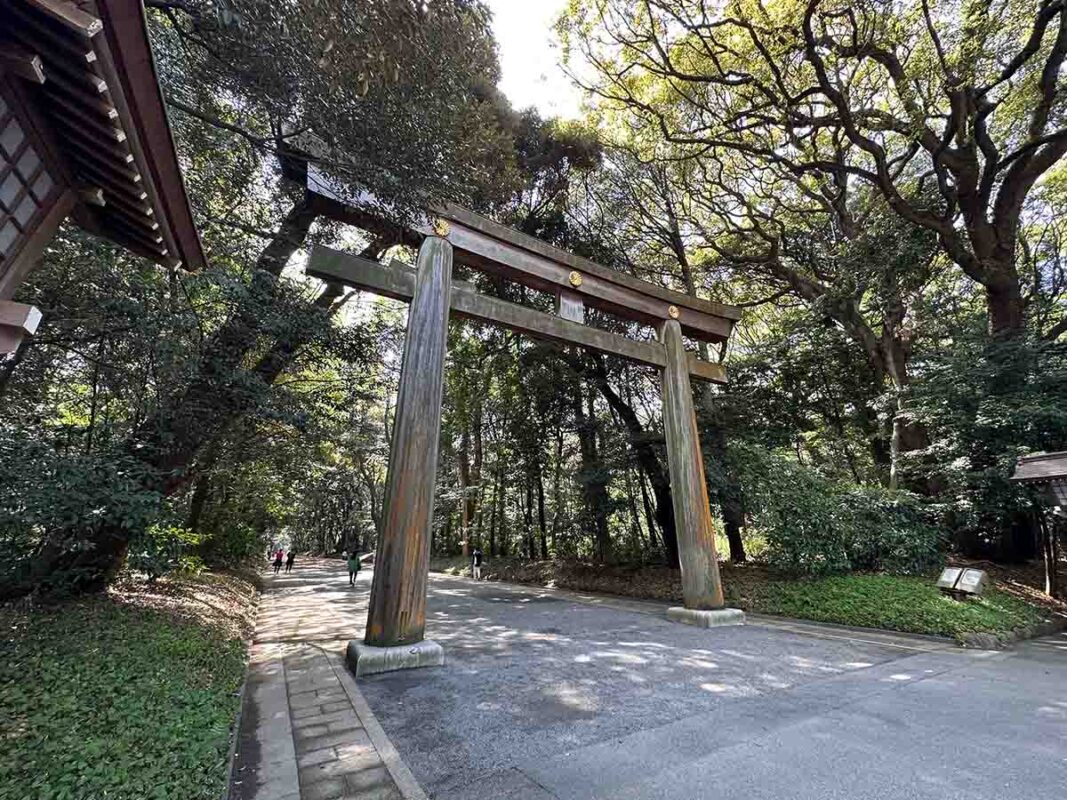
The highlight of the afternoon was a visit to Meiji Jingu, one of Japan’s most famous shrines.
Built in the 1920’s the shrine is dedicated to the spirits of Emperor Meiji and the Empress Shoken.
Located in a 70-hectare forest, it is surrounded by 234 different types of trees. As you wander along the main approach to the shrine it is quite hard to believe that the forest is actually man-made.
All the trees were donated from all over Japan and planted by 110,000 volunteers. Every tree was chosen on how it would look after 100 or 200 years. Today, it provides a calming experience as you wander along the long wide approach roads covered by a canopy of trees.
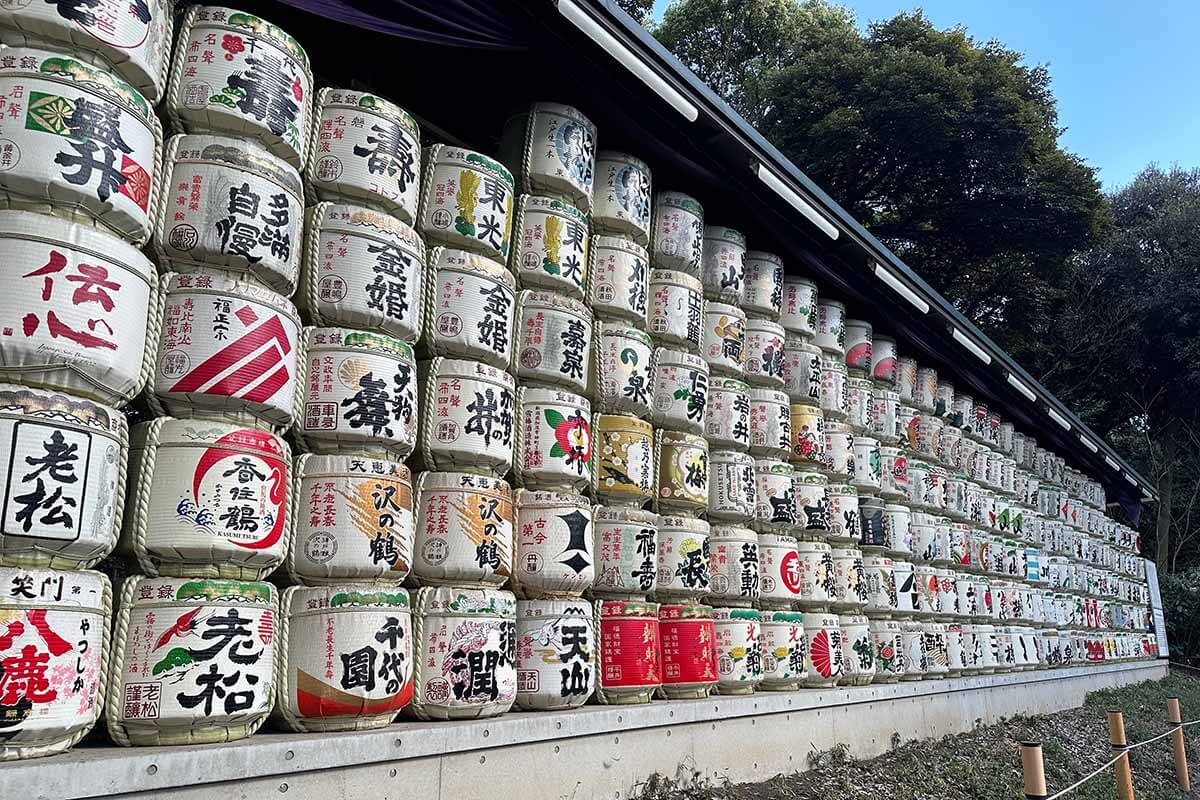
After a look around the shrine we also had the opportunity to look at the colourful sake barrel wall.
The sake barrels are all donated and are a gift to the shrine. They are empty though, with the sake used at ceremonies and festivals at the shrine.
Our final stop of the day was the Tokyo Metropolitan Government Building and its free observation gallery.
After visiting the Skytree a few days before I already had a bit of an idea of the size of Tokyo but it was interesting to see it from another angle. In particular, you really get to see the scale of the forest of Meiji Jingu and how it breaks up the urban landscape.

For dinner, we headed back to Kura, a sushi train restaurant which I think became a firm favourite with our group. We had some free time after dinner, so we had another wander around Senso-ji which was just around the corner from our hotel.
Tip | Head to the top of the Tourist Information Centre for an aerial view of Senso-ji in the day and at night.
Day 3 – Tokyo (free day)
Today was a free day. You had the choice of an optional tour with the guide or doing your own thing.
I did a bit of both.
The one thing you realise pretty quickly when in Japan is that you are going to have to get up super early or go out late if you want to get some photos without the crowds. Or if you want to avoid long queues for the Instagram hotspots (a couple of hours in some places!).
Thanks to a bit of jet lag I was still waking up at the crack of dawn so I decided to take advantage of this. I headed to Senso-ji to get some shots of the fabulous cherry blossom tree in front of the shrine.

Even at 6.30am, there were plenty of photographers and the odd Instagram photo shoot going on!
After breakfast, I joined the guide and some of our group for the optional tour, which was a tour around some of Tokyo’s popular cherry blossom viewing spots. Most of our group decided to do this and we spent a wonderful morning enjoying the blooms around the city.
Places visited included Rikugien Garden, Tennoji Temple, Yanaka Cemetery and Uneo Park. All looked stunning with the cherry blossoms trees almost in full bloom.
A traditional custom in Japan is Hanami, which translates to flower viewing. As we wandered around there were a lot of people enjoying Hanami, either by strolling around like us or by having a picnic with family and friends under the cherry blossom trees.
All too soon our tour came to an end and we had a free afternoon.
There was one other fellow solo traveller in the group so we headed to Shibuya. Luckily we managed to get a window seat in Starbucks (sadly now closed) overlooking the famous Shibuya Scramble crossing and enjoyed watching the madness while sipping a cuppa.
Afterwards, there was time for a little bit of shopping. A chance to pick up some Japanese versions of albums by my favourite UK bands at Tower Records (still miss that here in the UK) and wander the popular Takeshita Street.
It was very very crowded here so there wasn’t much chance to shop or try some of the colourful snacks as the queues were too long. One to put on the list for a return visit.
Heading back to our hotel, we managed to get on the wrong train. Thankfully we realised pretty quickly and were going in the right direction so it didn’t matter too much but was a first experience of getting lost on the public transport network.
Tonight was a free night.
Day 4 – Matsumoto
While it felt like we had barely scratched the surface of Tokyo it was time to move on and explore more of Japan.
Before that, we had to drop off our luggage at reception to be forwarded to Takayama. During this trip your luggage is forwarded three times. So, you are without your main luggage for a single night twice and two nights once.
That sounds much worse than it actually is. The luggage forwarding system in Japan is very efficient and having only an overnight bag did make it a little easier to navigate transport and move from city to city.
After taking an express train from Tokyo, we arrived in Matsumoto around lunchtime.
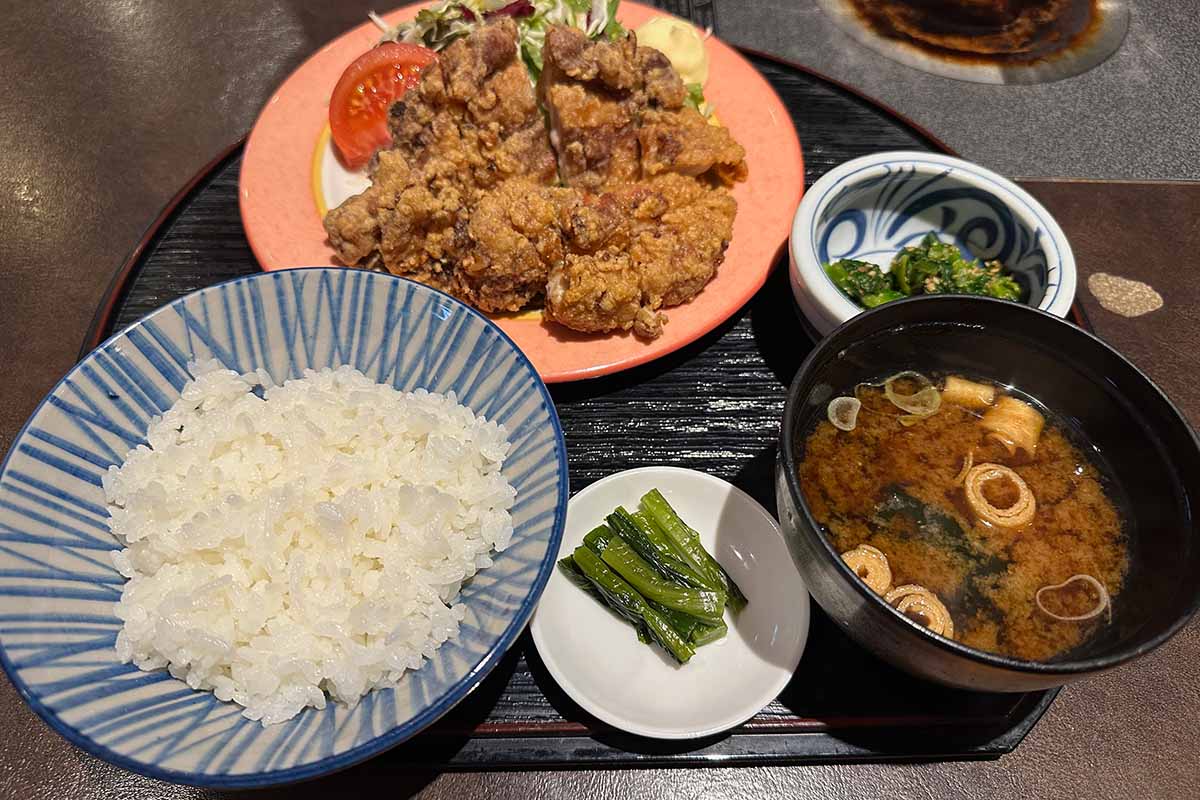
Our guide had booked us lunch at Shin Miyoshi and we had chosen our meals while on the train. I think most of us went for fried chicken, which is one of the local specialities. When we arrived it was pretty much ready and waiting for us. This was a great time saver although perhaps more importantly the food was amazing!
A double win.
Once we were all fed and watered, we dropped our bags off at the hotel and headed out to explore.
While Matsumoto is around two and a half hours from Tokyo, it feels like a world away. The huge crowds and urban landscape were replaced by mountain scenery, beautiful views, cute streets and hardly any crowds.
Located at the edge of the Japanese Alps, the city is most known for its iconic castle, one of five in Japan that are designated as ‘National Treasures of Japan’.
When I booked this trip Matsumoto was probably the one place I wasn’t too fussed about. It wasn’t really on my list of places I wanted to visit. However, it turned out to be a place I’m really glad it was on the itinerary.
That is another benefit of escorted group tours. They may take you somewhere you didn’t realise you wanted to see!
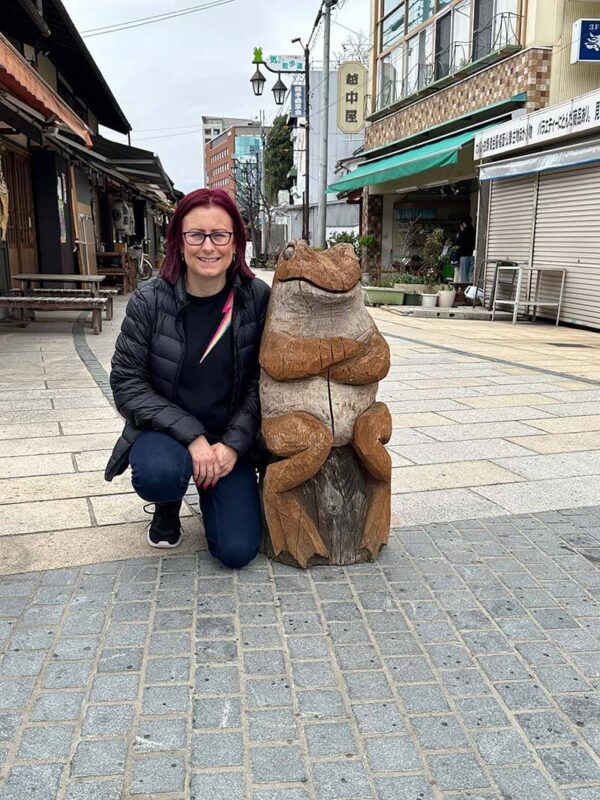
We headed to the castle via Nawate Street, a charming street lined with small shops and food vendors. The street is also known as Frog Street, thanks to the frogs that used to frequent the area.
They are long gone however frog statues welcome you to the street and there are plenty of frog figures dotted about.
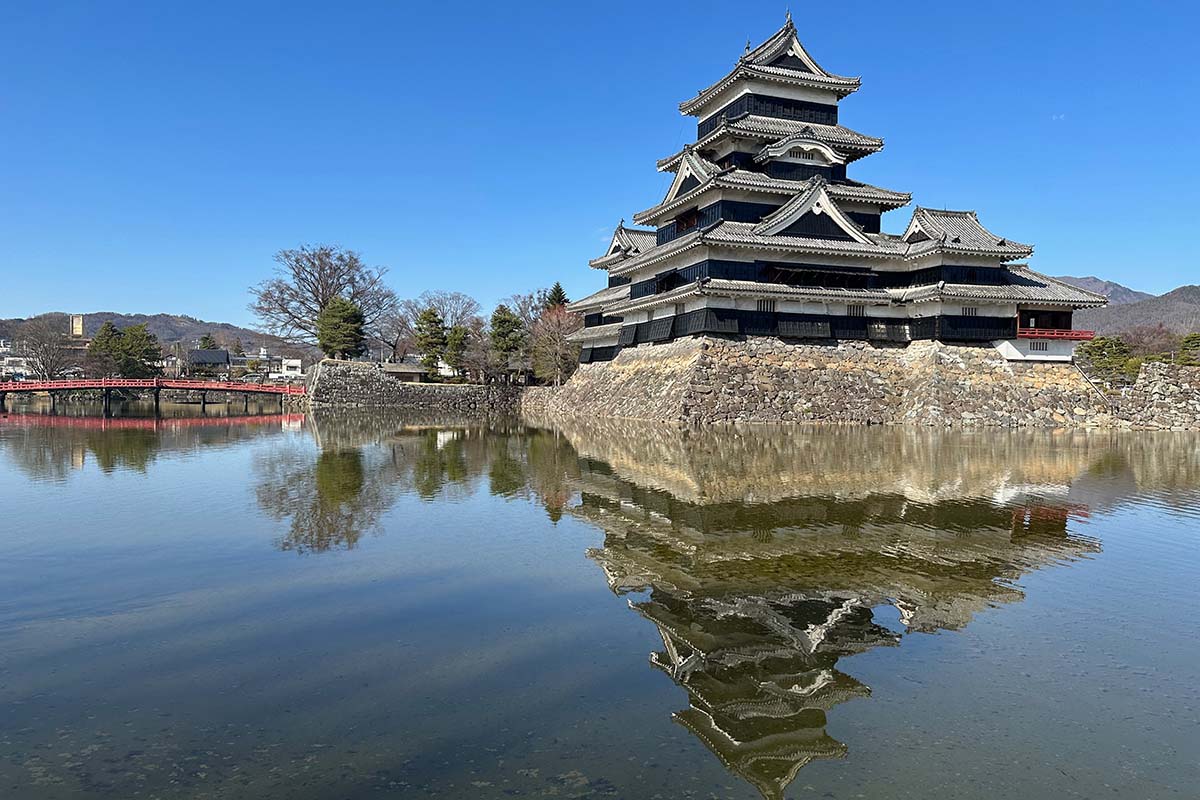
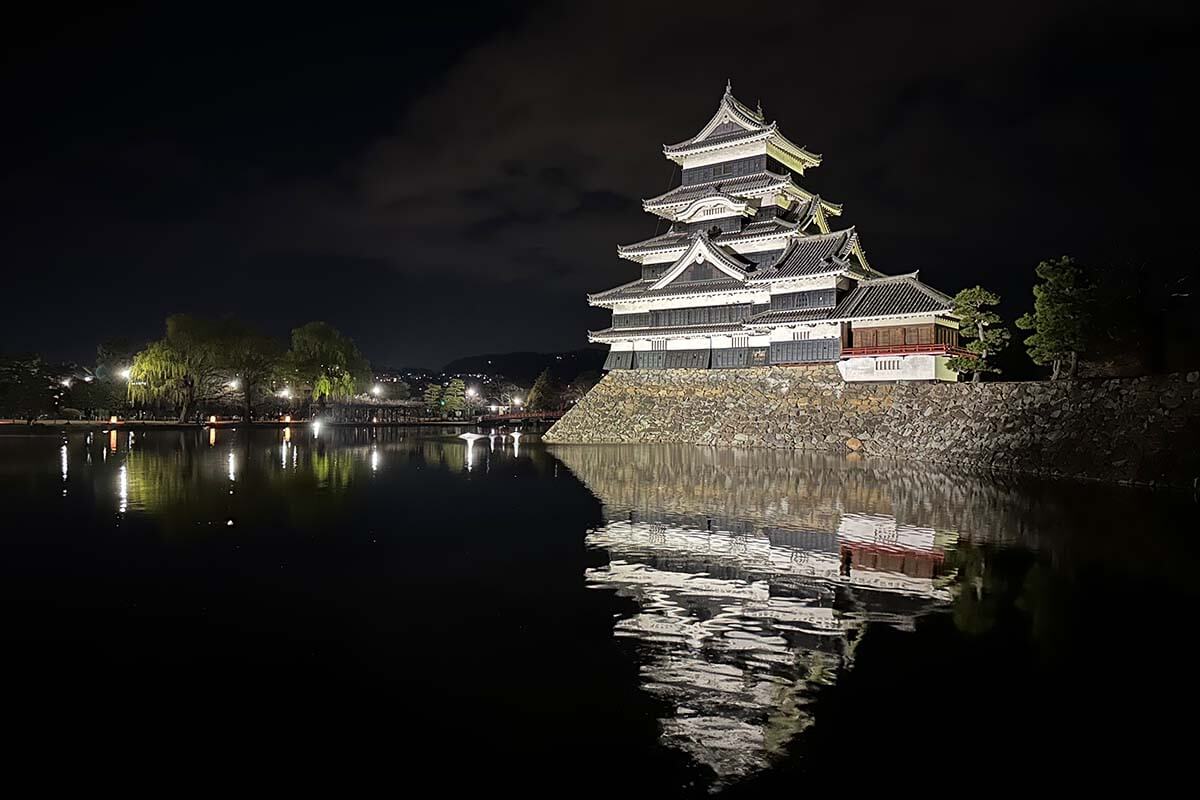
A short walk away is Matsumoto’s famous castle. Matsumoto Castle is one of Japan’s few remaining original castles. Built in the 16th century it has survived war, earthquakes and fires. Amazingly it is almost perfectly persevered.
Nicknamed the Crow Castle due to its black exterior, it is built on a plain rather than a hill or mountain. Set in a park, surrounded by a moat and with the spectacular Japanese Alps as a backdrop, all the pictures I had seen of the castle didn’t quite do it justice.
It is breathtakingly beautiful.
We were fortunate with the weather, the black of the castle providing a stunning contrast against the corn blue sky but I think whatever the weather, the castle would look magical.
While it is free to enter the outer grounds you can go inside for a small fee and climb to the top of the five-story castle.
Inside there are very steep ladder stairs between each floor (a challenge when just in your socks!) and some low beams to look out for. It was also very crowded although orderly as everyone shuffled their way through.
When you reach the top you are rewarded with a view over Matsumoto and beyond.
Tip | Head back to the castle after dark to see it illuminated. It looks truly spectacular.
Day 5 – Matsumoto to Takayama
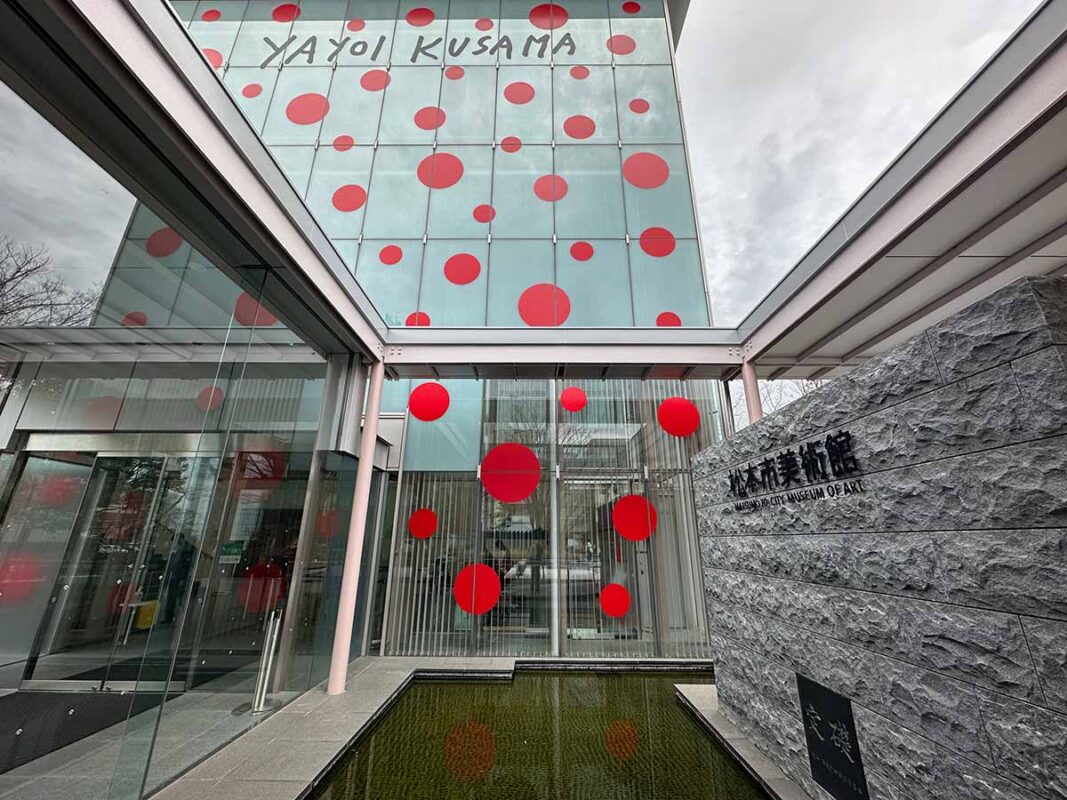
I was a bit surprised today that we had the morning to explore more of Matsumoto. I just assumed we’d be heading off first thing. However, I was very glad we didn’t as it allowed us to visit the Matsumoto City Museum of Art.
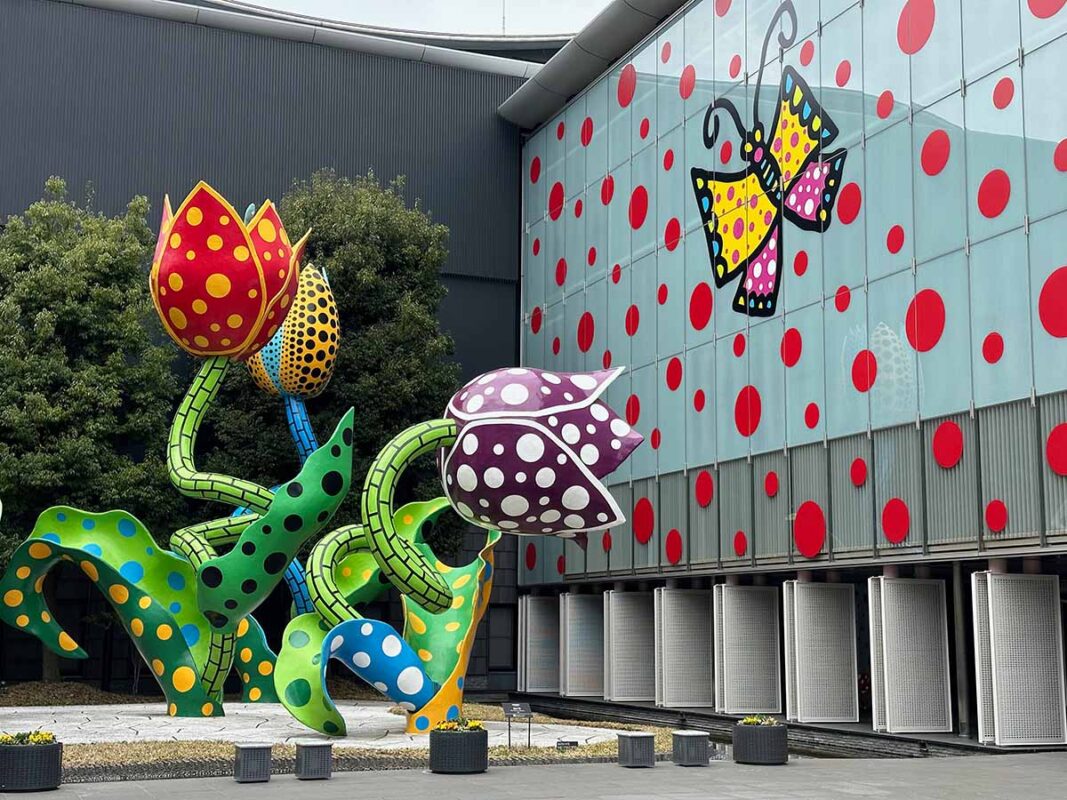
This was high on my list of places to see here as it has an exhibition by Yoshi Kusama as well as one of her artworks on the forecourt.
I visited the Infinity Mirror rooms at the Tate Modern in London last summer and loved it. So, once I learned Matsumoto was her hometown, with a permanent collection of her distinctive work on display in the local art museum, I knew I wanted to visit.
It did not disappoint.
Titled ‘The Place for My Soul’, it was a fascinating look at her life and art. If you visit Matsumoto, it is definitely a must-see.
All too soon it was time to head to Takayama. We took a public bus, a 2 ½ hour journey (with a comfort break stop) through the mountains.
Located in the heart of the Japanese Alps, Takayama is a bustling market town.
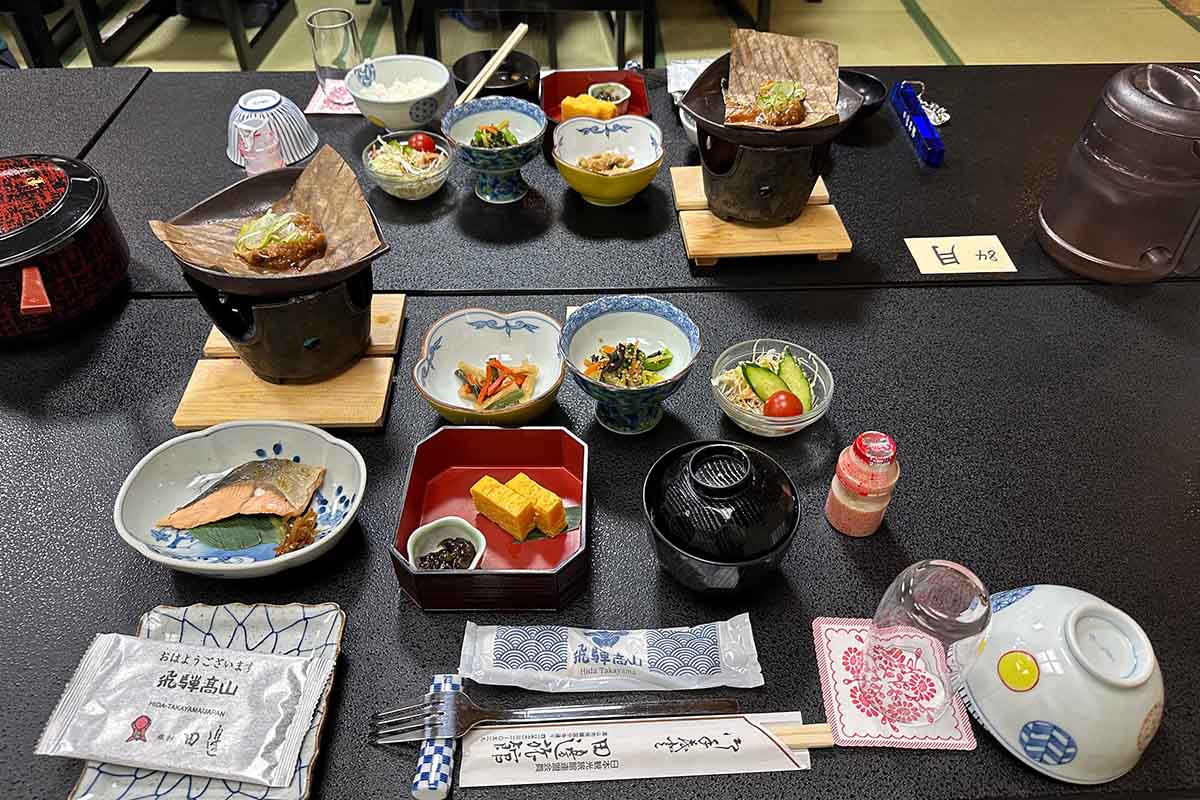
Inside Japan aim to give you the full Japanese experience on their tours. So, here in Takayama, we stayed in a Ryokan for two nights. A Ryokan is a traditional Japanese inn with tatami mat rooms, futons to sleep on and communal baths.
Dinner was also included tonight and the Ryokan provided us with a traditional multi-course Kaiseki dinner. Beautifully plated with local and seasonal dishes it was an experience to remember.
Day 6 – Takayama
After a traditional breakfast, we spent a full day exploring Takayama with a local guide.
First, we had a wander around the Miyagawa morning market.
Around 60 stalls line the river selling everything from fruit and vegetables to Japanese crafts and sweets. It is a great place to pick up some Japanese souvenirs including a sarubobo (monkey baby) which is the town’s good luck mascot.
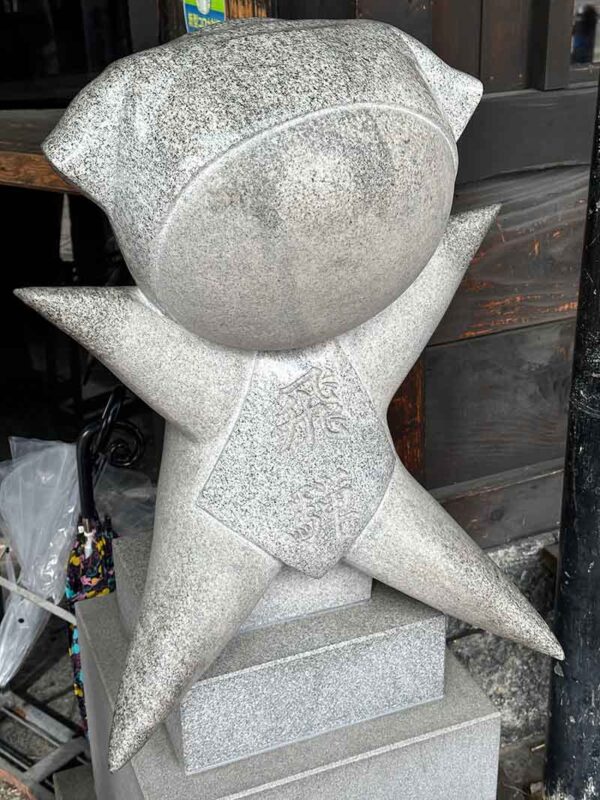
This is perhaps where the disadvantages of a tour become apparent as we didn’t have much time here.
It was just enough to get a feel for it and do a little shopping or try a snack. However, it would have been nice to have been able to spend more time here. Another place to put on the list for a return visit one day.
Next on our schedule was a visit to the Hida Folk Village. A short bus ride out of town, this open-air museum is a glimpse into what life may have been like in the Japanese Alps centuries ago.
The 30 buildings and farmhouses, which date back 200 years, were relocated here to recreate the area’s historical look.

After a tour of some of the key buildings, there was some free time to wander around and take in the area.
Returning to Takayama, we had lunch at a local restaurant where we tried the local speciality Hida beef.
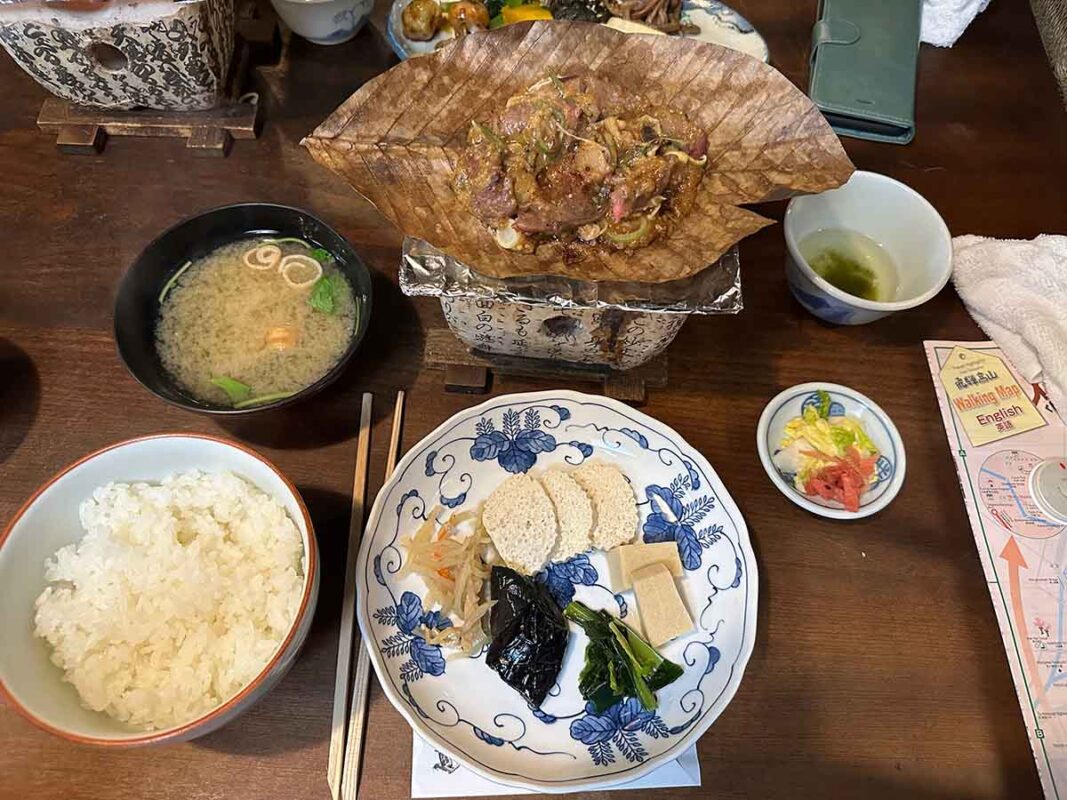
After lunch, we visited Takayama Jinya, the town’s old government building that is now a museum.
During the Edo period, it was a local governor’s office and where the region was ruled from. It was still in official use up to 1969. One of the most fascinating parts of the afternoon was learning our local guides’ parents used to come here to speak to officials and pay their taxes.
The rest of the day and evening we were free to wander around and explore Takyama ourselves. A few of us opted to go with our guide for dinner to try the local ramen. A good choice as it was perhaps the best all tour.
Tip | Always go to dinner with the guide, they know the best places!

Day 7 – Takayama to Kanazawa
The morning started with another traditional breakfast, although with a few different dishes compared with the day before.
Then we hopped onto a private bus for the journey to Kanazawa. After dropping our bags at the hotel, we headed straight to Omicho Market, a large fresh food market, for a wander and lunch.
One of the things Kanazawa is famous for is gold leaf. This is where gold is hammered and flattened into thin sheets and used make and cover all sorts of items. It is even edible, so I couldn’t pass up the opportunity to try some gold leaf ice cream.
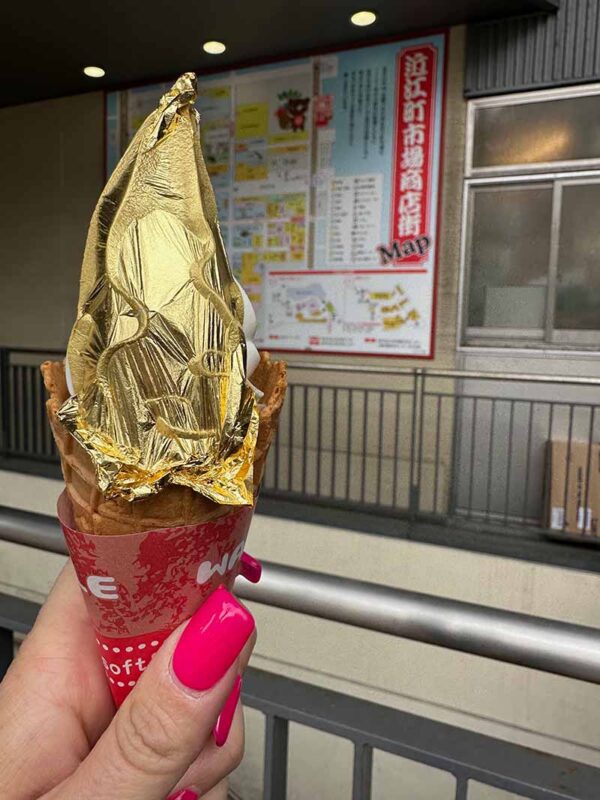
The afternoon we spent wandering around the sights of Kanazawa.
The first stop was Oyama Shrine, a Shinto shrine that dates back to 1599. Although it was originally located elsewhere but was moved to its current location in 1873. The striking gate at the entrance to the shrine is a mix of Japanese, Chinese and European architectural styles.
The shrine has a beautiful garden with a large water feature that you can walk around. It was very tranquil.
Then we headed over to Kanazawa Castle Park. Originally built in the 1850’s Kanazawa Castle has been expanded and rebuilt over the years after multiple fires.
What stands there today is mostly a reconstruction based on how the castle would have looked when it was first built. However, it still looks impressive. Even more so as I was very fortunate to be in Kanazawa for full bloom so the cherry blossom trees were overflowing with flowers as we entered the park.
Before visiting Japan, I didn’t really think there would be much difference between first bloom and full bloom but you can really tell the difference. In full bloom, the flowers seem both fluffy and light while weighing down the trees at the same time.
With the castle as a backdrop, they look beautiful, even on a slightly cloudy day.

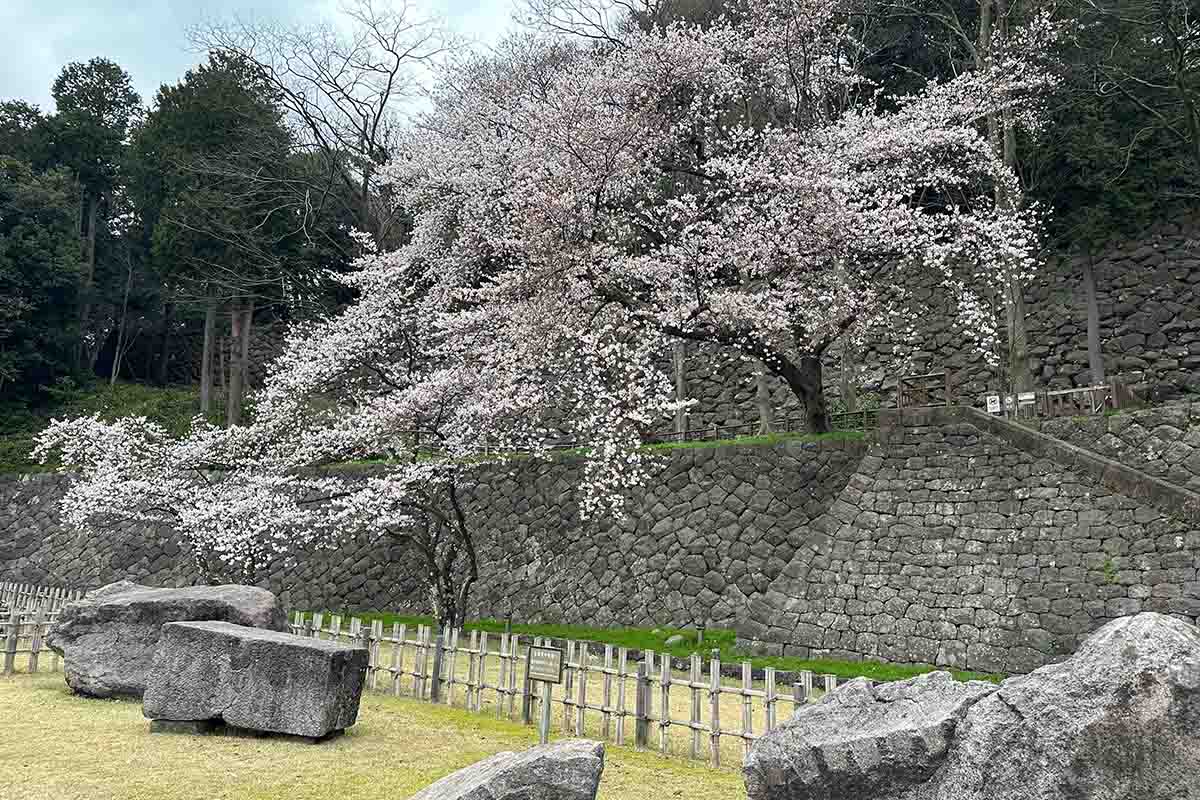
Tip | Head back to Kanazawa Castle Park after dark to see the castle and gardens illuminated.
Once inside the park, we had a brief stop at the Gyokusen’Inmaru Gardens.
This garden was opened in 2015 after being restored to how it would have looked at the end of the Edo period. A viewing platform provides the perfect view of the serene garden.

The gardens we had seen up until this point were lovely however, the jewel in Kanazawa’s crown is Kenrokuen Garden. Widely considered one of the three most beautiful gardens in Japan, it is one of the most popular places to visit in Kanazawa.
The name Kenrokuen name refers to the six essential attributes that make up the perfect garden. Kenrokuen has them all and more, it really is a stunning Japanese garden.
I think Kenrokuen would be lovely at any time of the year but feel particularly fortunate to have seen it during the cherry blossom season.
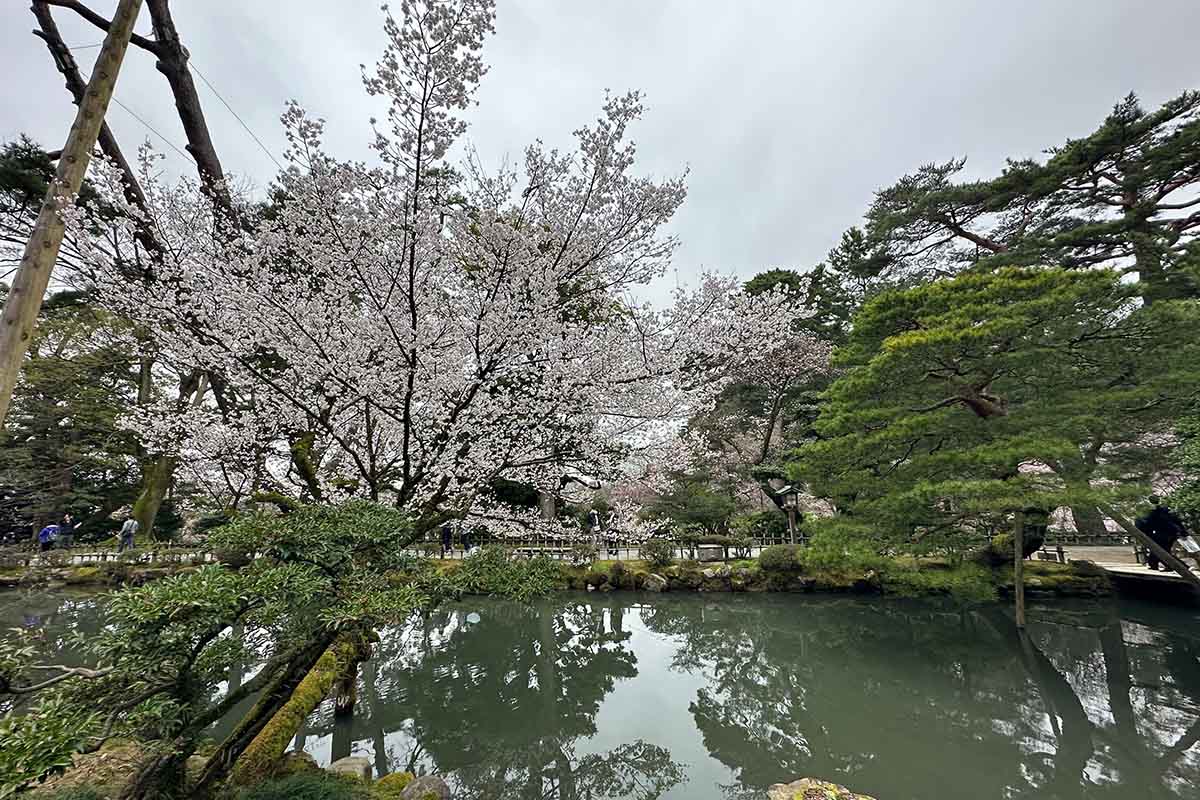
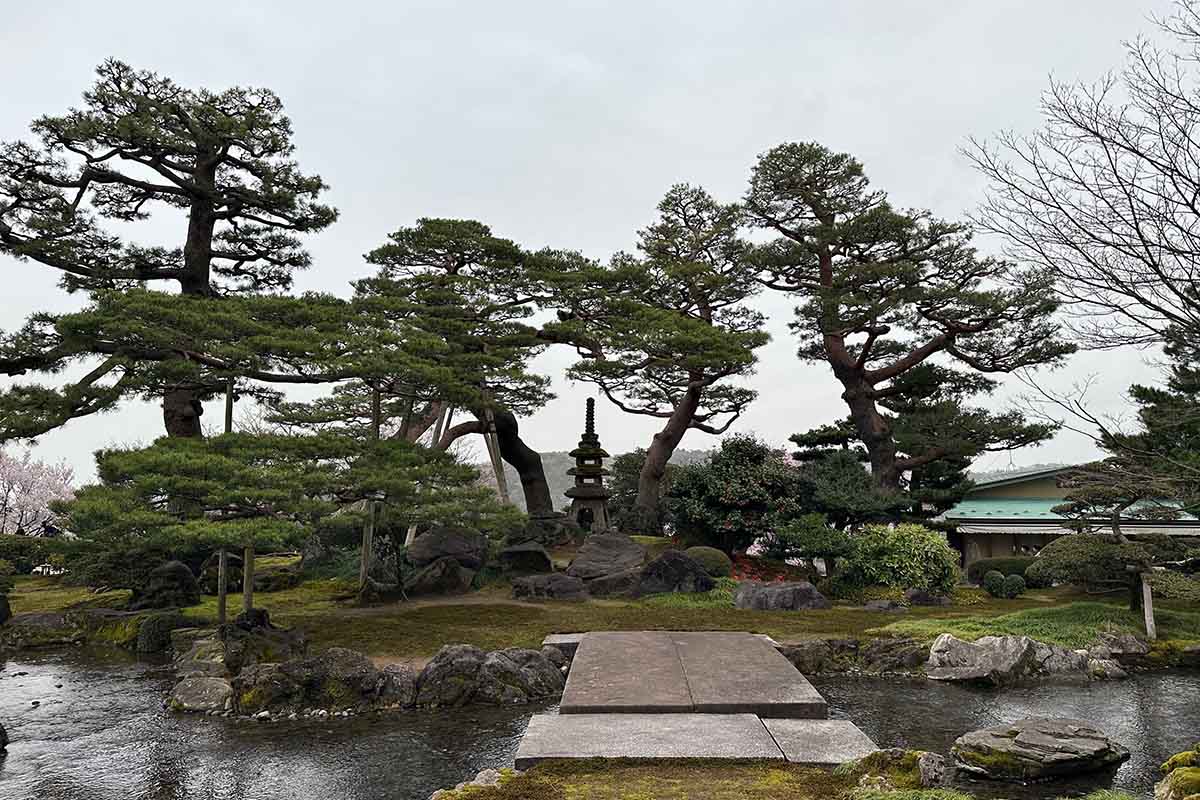
The remainder of the afternoon was spent strolling around Kanazawa including visiting two of the three Geisha districts Kazuemachi and Higashi Chaya.
Sometimes described as Little Kyoto, Kanazawa has much of the charm of Kyoto but without the huge crowds.
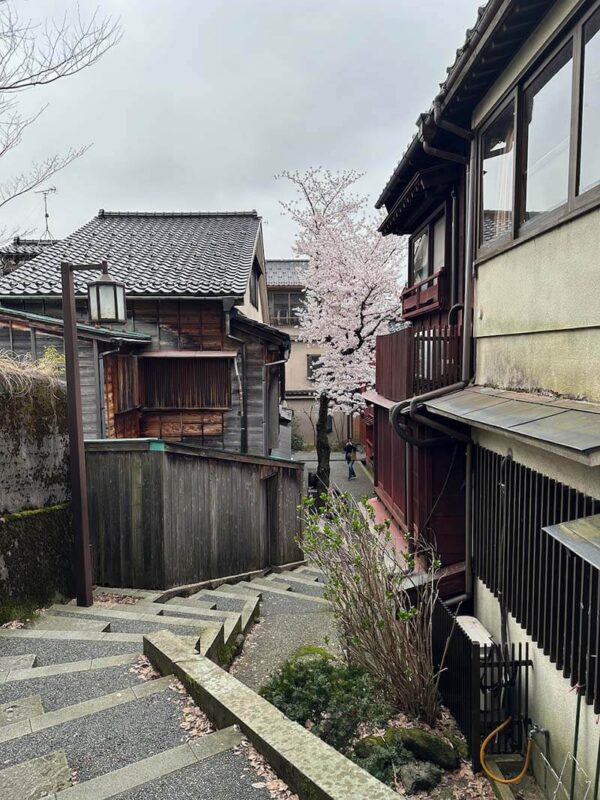
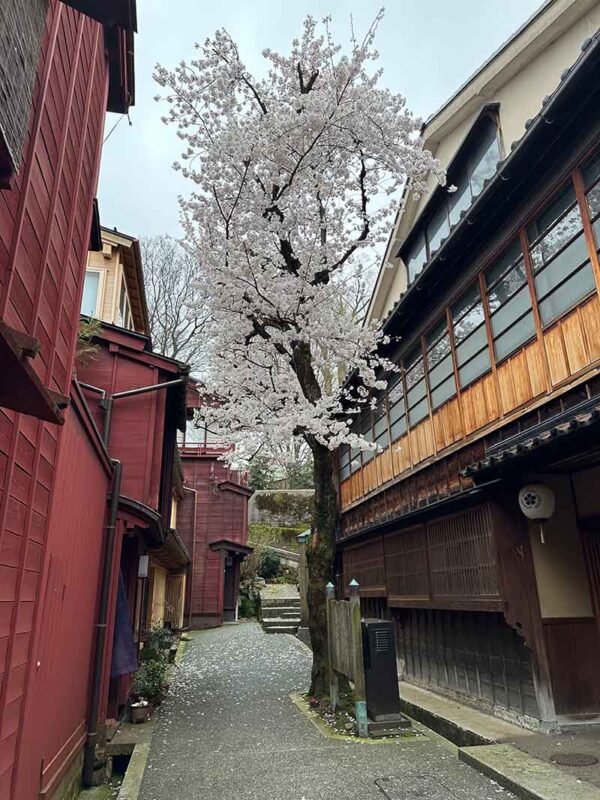
Tonight was a free evening. Being a busy Saturday night we struggled to find somewhere to eat.
You often hear about Japanese hospitality and how people sometimes go out of their way to help you. This was definitely the case in Kanazawa.
My fellow solo traveller and I were standing outside a restaurant looking forlornly at the fully booked sign when a Japanese couple left a restaurant an asked if we wanted to go in.
Yes, please.
So they popped back inside, spoke to the manager and within five minutes we were gratefully sitting at a table inside.
Day 8 – Kanazawa to Kyoto
Today was probably one of the days I was most looking forward to on this tour. We were heading to Kyoto and had a private audience with Maiko, a trainee geisha, in the afternoon.
First, we had to get there though. We headed to Kanazawa station to catch a train to Kyoto. The station is known for the Tsuzumimon Gate, a huge wooden gate located at the east exit and not to be missed if you are passing through the station.
After dropping our bags at the hotel, it was straight out to explore Kyoto. Our cherry blossom good fortune continued, with Kyoto being in full bloom.
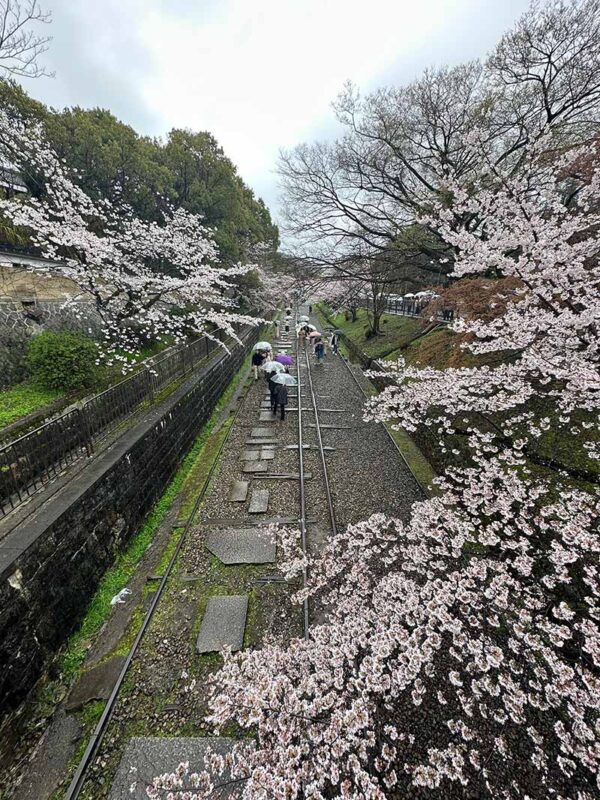
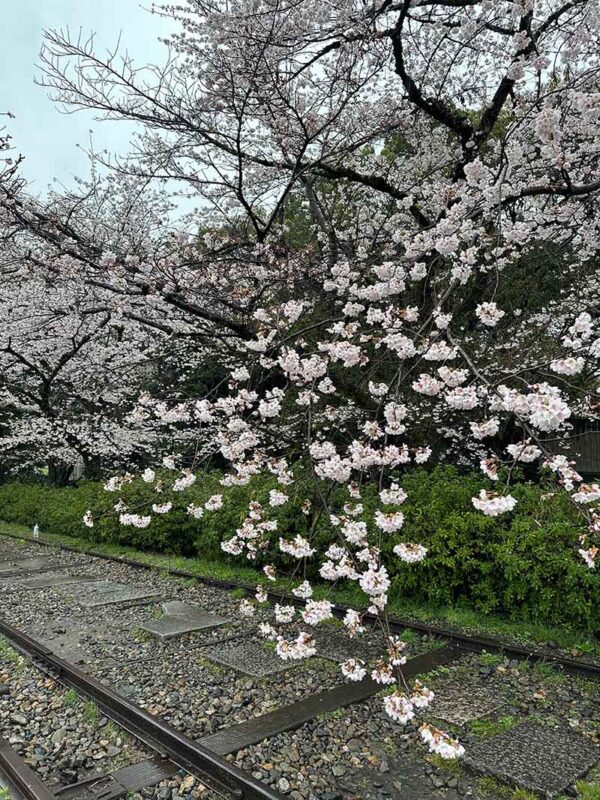
We had a lovely wander along Keage Incline, a former railway line that has been converted into a pedestrian walkway lined with cherry blossom trees. Even the light drizzle couldn’t take away from the beauty of the trees as we took a slow wander along the tracks.
Our next stop, a short walk away, was Nanzen-ji, a Zen Buddhist temple.
While the history of the site dates back to 12th century, the temple itself has been destroyed and rebuilt over the years. The current temple was built in 1909. We spent a little time here admiring the magnificent Sanmon Gate and more cherry blossom trees.
After returning to the hotel for a quick freshen up, it was back out for our private audience with a Maiko. Inside Japan have links with a tea house in Gion that enables them to provide this experience on some of their tours.
We spent around 45 minutes with the Maiko. This included afternoon tea and the Maiko entertaining us with a spring dance and a traditional game, which was definitely harder than it looked.
We also had the opportunity to ask questions and learn more about the Geisha world. It was an enchanting experience and one I’ll never forget.
The thing that surprised me most was that we could take photos the whole way through. l really wasn’t expecting that. I thought if we were lucky we would perhaps get a group photo at the end.
Instead, we could take photos throughout and each got an individual photo and group one at the end. While you don’t want to spoil the opportunity by viewing it through your phone or camera, it was nice to be able to take a few snapshots as a memento.
I’d love to share them here but I don’t think is right to publish them. However, Inside Japan have a great video which gives an insight into what it is like to meet a Maiko.
All too soon we were back out in the evening Kyoto drizzle.
We had a bit of time to kill before our dinner reservation This was where our guide definitely earnt his money by trying to keep a wet and tired group occupied until it was time to head to a local restaurant.
We saw some more cherry blossom spots, the blooms still sparkling even in the rain.
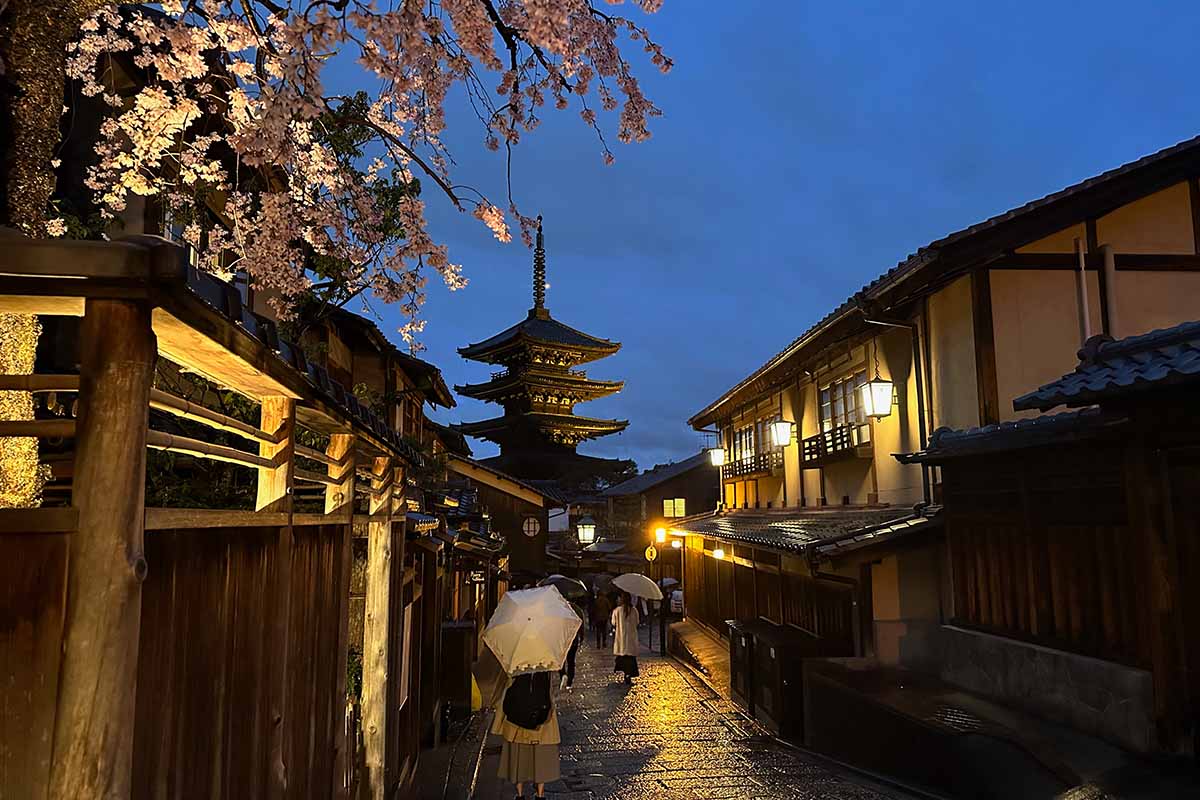
We also wandered along Yasaka Dori with the Yasaka Pagoda towering over the street. Even though it was a Sunday evening it was still pretty crowded here although the rain and umbrellas gave an atmospheric feel.
After dinner, some of us joined the guide to walk back to the hotel via more of Kyoto’s cherry blossom spots including Gion, Maruyama Park and Yasaka-Jinja.
It was a lovely experience, there seemed to be cherry blossoms everywhere. Many were lit up and almost glittering against the night sky. There was also a festival with street food and snacks. Many people were out and about enjoying the evening.
Day 9 – Kyoto
Kyoto has 17 UNESCO World Heritage sites and plenty of other amazing things to see, however, they are spread out around the city.
So, Inside Japan provided a private coach to take us around some of Kyoto’s sights. Having this definitely saved us some time enabling us to see as much of Kyoto as possible.
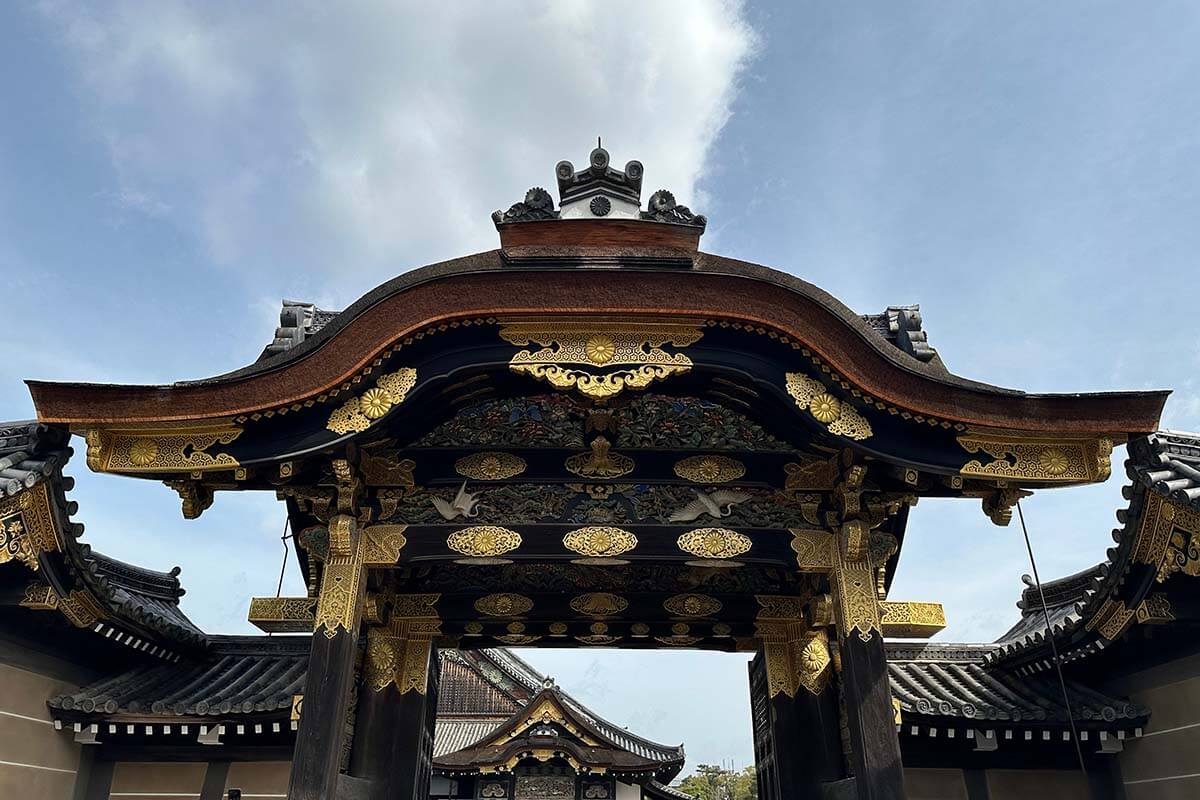
Our first stop was Nijo Castle. With a history dating back over 400 years Nijo Castle has overseen some of the most important periods in Japanese history.
It was built on the orders of the first shogun of the Edo period, Tokugawa Ieyasu and was his residence when he visited Kyoto. So perhaps it is not surprise it has been designated a UNESCO World Heritage site.
While not all the castle has survived the years, the Ninomaru Palace, Kara-mon Gate and the Ninomaru Gardens have and provide an insight into architecture from that era.
The castle underwent a full scale renovation in 2011 (the first major repair work since the castle was built!) to help preserve it for generations to come.
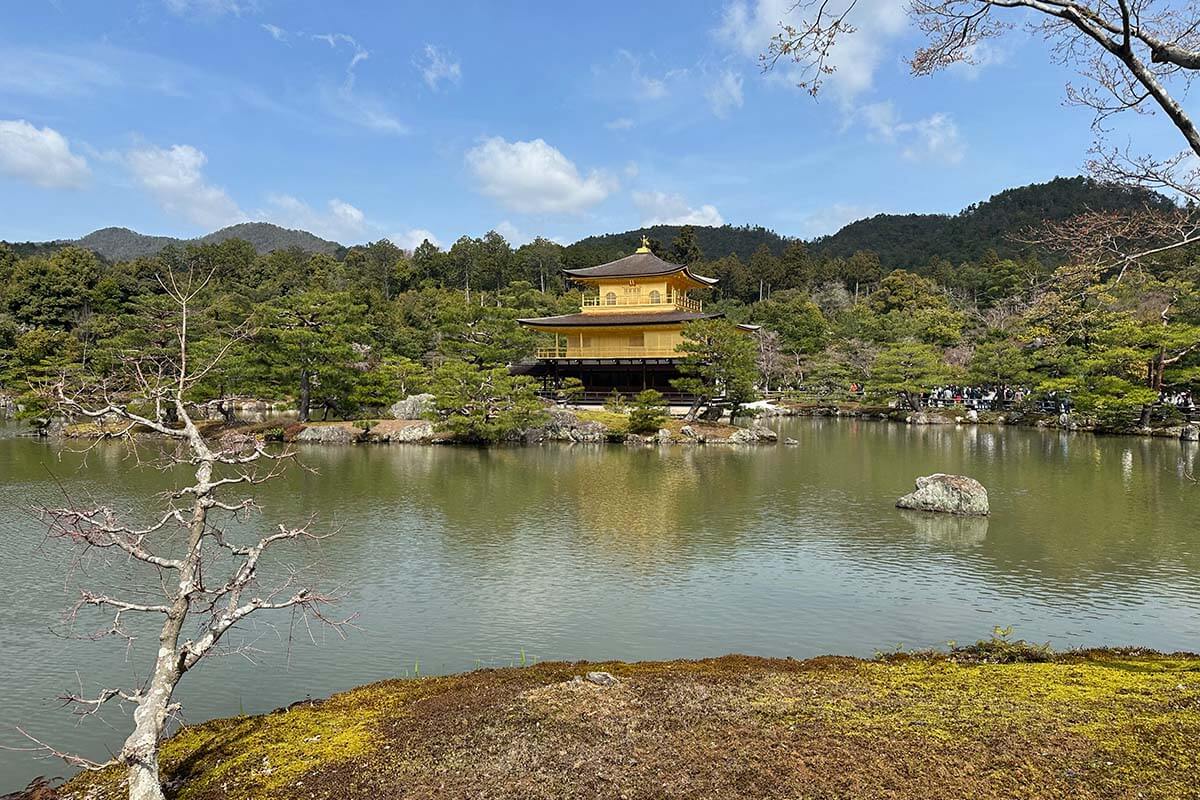
Our next stop was Kinkaku-ji, a Zen Buddhist Temple and one of the most popular places to visit in Kyoto.
Although the original pavilion is long gone, the reconstruction that was built in 1955 is said to be very similar. Three stories high, the top two are covered in gold leaf. Situated on the shores of a lake, the temple sparkles in the sunlight and reflects in the lake.
While it was crowded it was fairly easy to grab a spot to take a photo or two. Definitely one for the gram.
Lunch was spent in Arashiyama which is located at the foot of the mountains on the outskirts of Kyoto.
Known for its beautiful scenery and famed bamboo forest, Arashiyama is a very popular spot. So it was no surprise to find it super crowded here.
However, we managed to find a place to eat surprisingly easily – with all the Brits on the tour gravitating to the pie shop!
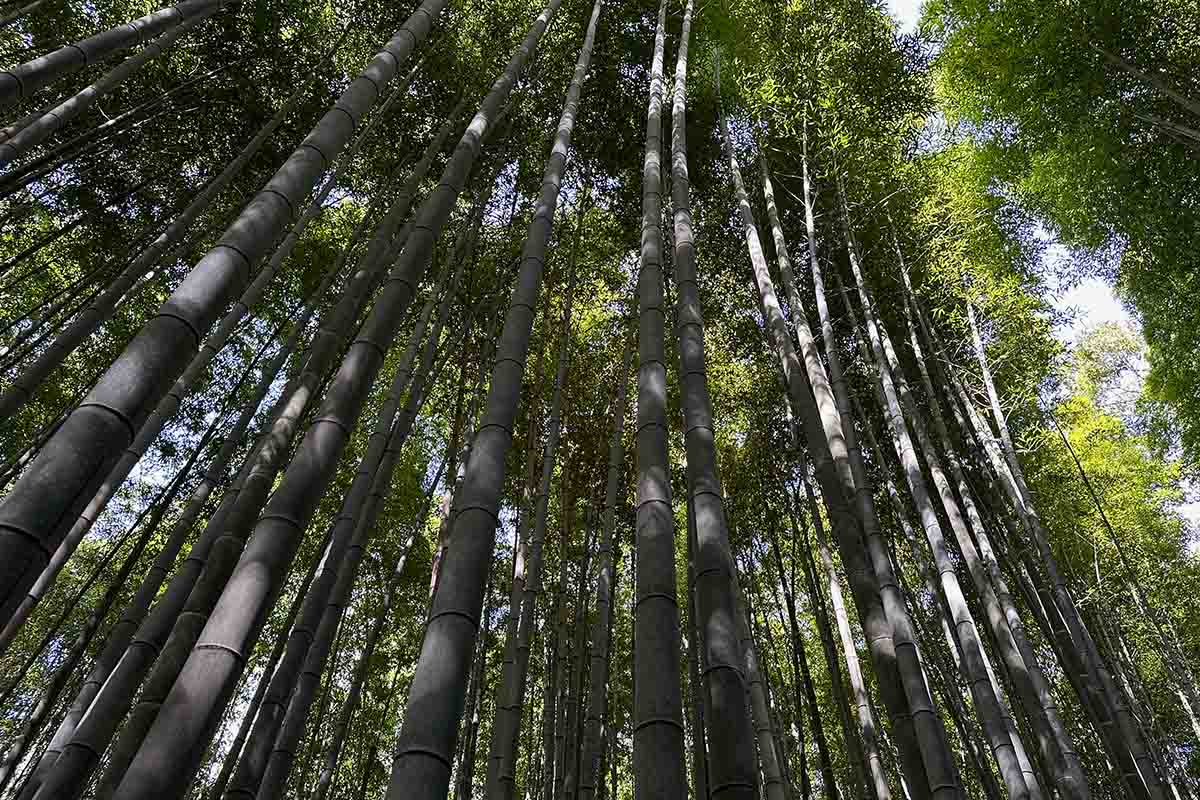
A wander around Arashiyama Park and the bamboo grove followed.
The enchanting forest is an instagram hot spot. However, if you are hoping to get a shot of you strolling along the forest or posing in front of the bamboo trees with no one in the background you’ll find it pretty tough unless you get there super early.
While it wasn’t as crowded as it could be, there was no chance of any photos without people in.
Before we left Arashiyama, we had time to visit one more temple, Tenryu-ji temple.
Another of Kyoto’s famous UNESCO world heritage sites, the Zen temple was built in 1339. Over the years numerous fires damaged and destroyed the temple and subsequent rebuilds. Most of the buildings on the site are reconstructions.
Tenryu-ji is also known for its beautiful pond garden. Designed almost 700 years ago, a path runs alongside the pond allowing for picturesque views from all angles.
Before long it was time to get back on the bus for the highlight of the day and perhaps the tour.
Every spring the traditional Geisha quarters of Kyoto each perform a spring show. A ticket to one of these shows is included in the price of the Spring Elegance tour.
As I went in March we had tickets to the Kitano Ordori which is performed between mid-March and early April.
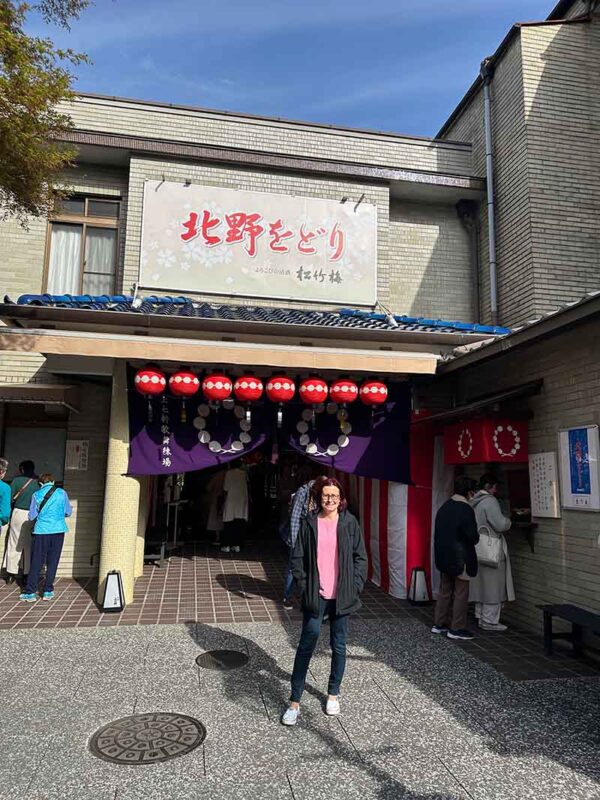
The first half of the show was a play which although it was obviously in Japanese, was fairly easy to follow along with. A love story is a love story in any language!
The second half of the show was the Maiko’s and Geisha’s performing dance pieces. It was all beautiful but the last scene in particular was stunning with all the Geisha’s and Maiko’s on stage together.
It is something that will stay with me forever.
Day 10 Kyoto (free day)
Today was a free day. Options available included exploring more of Kyoto, a day trip to Osaka or travelling further afield to Hiroshima.
Me? I wanted to take a trip on the Hello Kitty Shinkansen.
So, I decided to take a day trip to Himeji Castle which would allow me to experience the Hello Kitty train on the journey there.
Before that though, our guide had planned an optional trip to Fushimi Inari first thing in the morning. While you may not recognise the name, you would most likely know the iconic image of a tunnel of red torii gates stretching as far as you can see. It is one of Kyoto’s most famous sights.
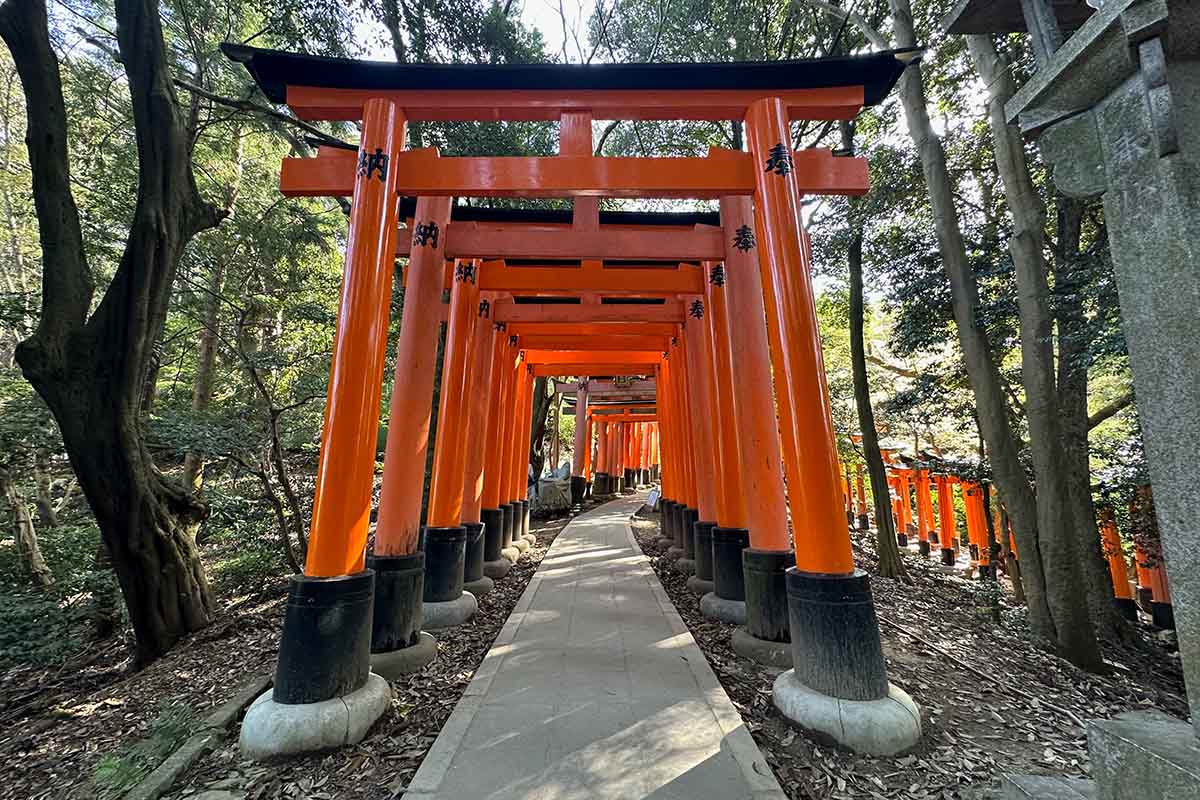
The shrine is located at the base of Mount Inari. Over 10,000 Torii gates wind their way through the wooded forest on the mountainside. Fushimi Inari is dedicated to the Shinto god of rice and sake, Inari.
As head shrine to over 30,000 shrines, it is one the most important shrines in Japan. It is also one of the most popular so you can expect huge crowds here at peak time. As we returned to the entrance to the shrine, it was starting to get busy so it was a good idea to go early.
Our group then went our separate ways for the day.
Although there are direct trains from Kyoto to Himeji, the Hello Kitty Shinkansen departs from Osaka. Thankfully, it only takes around half an hour to get to Osaka from Kyoto so we made it with plenty of time to spare.
The Hello Kitty Shinkansen runs between Osaka and Hakata and is the slowest of all the Shinkansen services. That didn’t really matter though, it’s the Hello Kitty experience that makes this train fun rather than its speed.

The train is decorated with Hello Kitty decals and motifs inside and out. However, it is really only the first two carriages that are fully kitted out.
Hello Plaza, the first carriage on the train, is really just a shop. You can buy plenty of themed merchandise here, while the second carriage has Hello Kitty-themed seats and a life sized model you can grab a photo with.
For fans of Hello Kitty it is a great experience.
Read more | What is it like riding the Hello Kitty Shinkansen
After around 40 minutes, we arrived at Himeji. Exiting the station, you can see the city’s famous castle in the distance. It takes around 20 minutes to walk up to the castle grounds.
Access to the castle was restricted due to how crowded it was but it only took around half an hour to get inside.
There were six flights to the top, with some very steep stairs. However, you were rewarded with a panoramic view of Himeji once you reached the top of the castle. That’s if you could get to a window. It was very busy at the top. You had to shuffle along with the crowd.
I was lucky to visit during the cherry blossom season and the pink blooms provided a stunning foreground to the white castle.

Next door to the castle is the Koko-En Garden. Made up of nine walled gardens, each designed in a different style, it was a pleasant place to wander around and escape the crowds of the castle.
Tip | You can buy a combined ticket that gives you access to both the castle and garden for just 100 yen more than the castle only ticket.
Before heading back to the train station we grabbed a snack at the food festival outside the castle. I managed to try one of the famous 100 yen cheese coins. While you may not think sweet batter and mozzarella cheese go together, it was every bit as good as I had read.
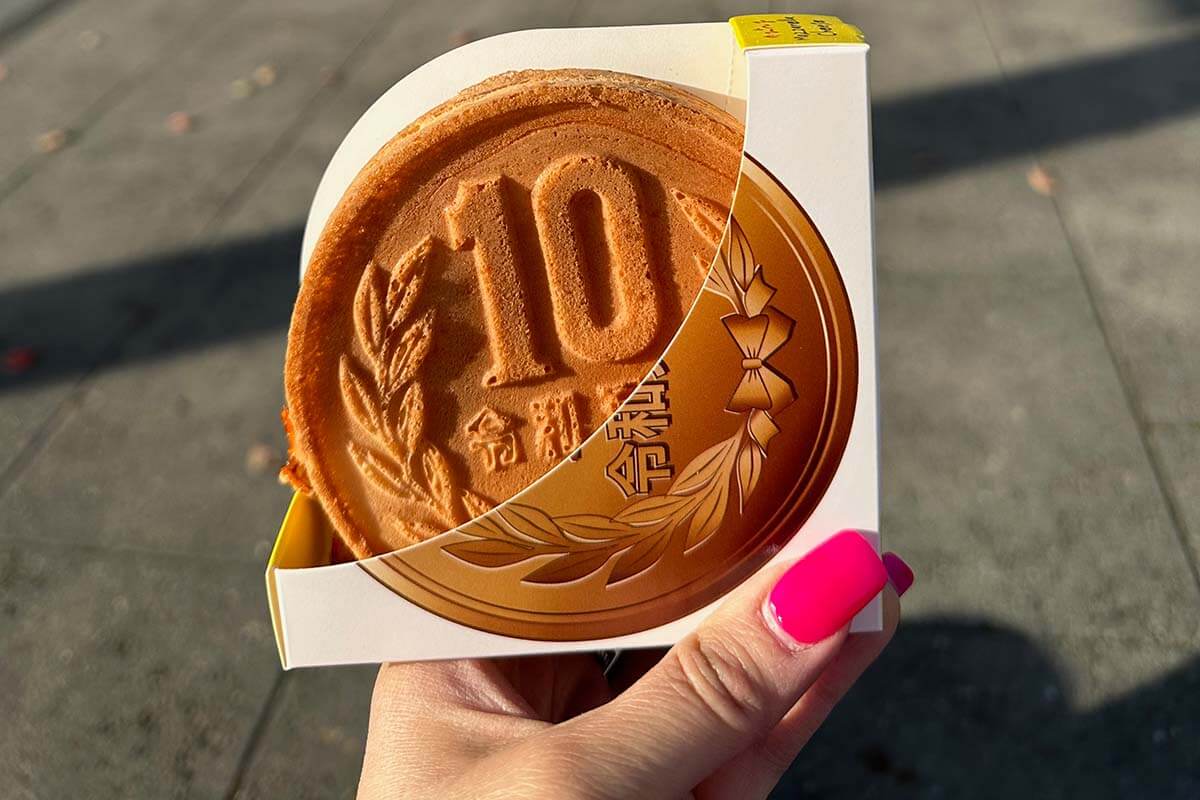
The evening was free time.
Day 11 – Kyoto to Hakone
You could probably spend a week in Kyoto and still not see even half of it. However, our three nights seemed to come to an end quickly and it was time to head to Hakone, and hopefully a get a glimpse of Mount Fuji.
If I’m being honest this is one part of the trip I thought I wasn’t that fussed about. Seeing Japan’s famous volcano wasn’t really on my list of things I wanted to see. That is definitely another advantage of an escorted tour, they take you to locations you didn’t think you wanted to see but turns out you did!
It was a long journey to Hakkone. Seven trains in total, including a delayed bullet train – a rare occurrence apparently!
When we arrived we headed straight to the Hakone Open Air Museum. With its mountain backdrop and (strange) sculptures dotted around the park, you can easily lose a few hours taking it all in.
Artworks and sculptures by both Japanese and Western artists are displayed here. There is also 300 of Picasso’s artworks in a special pavilion dedicated to the artist.
We were lucky with the weather, it might not have been so much fun if it had been raining but it was a nice way to spend the afternoon.
Dinner tonight was at a local restaurant and as always was delicious. Definitely one of the best of the tour.
Day 12 – Hakone
Hakone is known for its hot springs and views of Mount Fuji.
Today we had a full day to explore the mountain town using the Hakone Free Pass. It’s not actually free but it does include many things including a cruise across Lake Ashi and unlimited public transport in Hakone so it is a good deal.
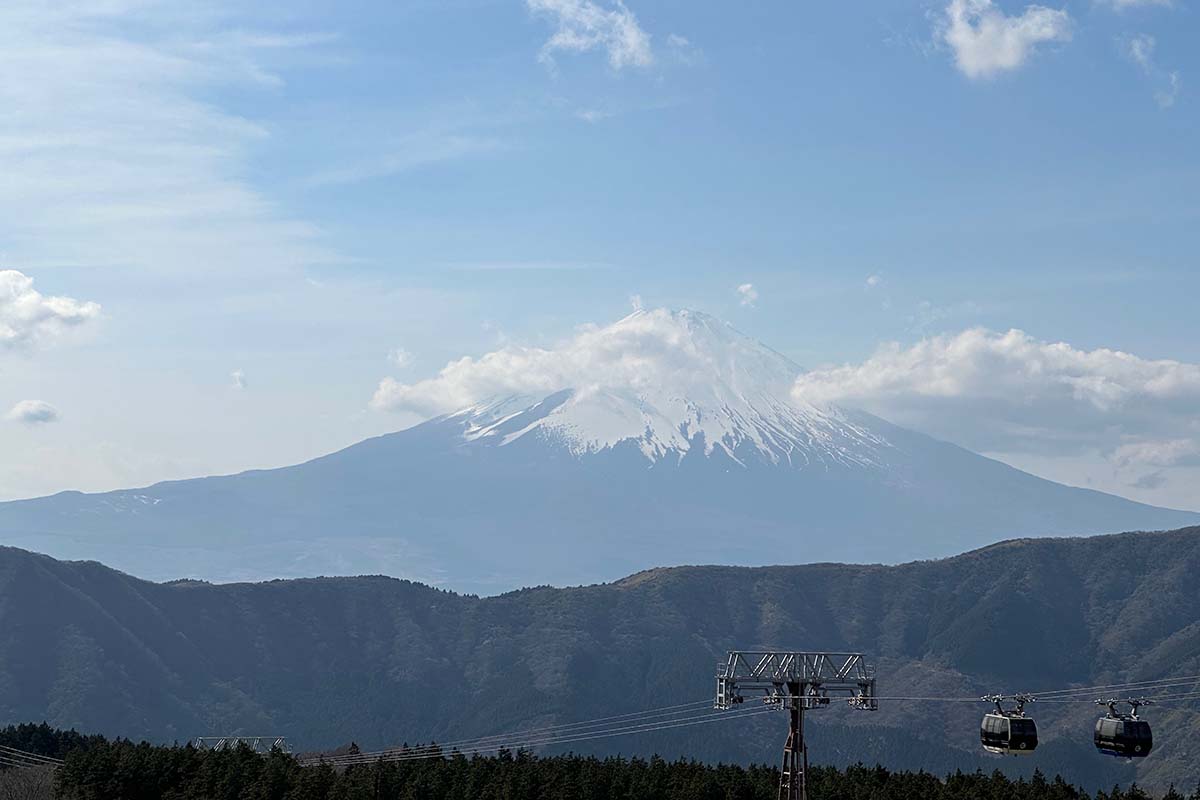
We caught the ropeway and were lucky enough to catch a glimpse of the top of Mount Fuji peeking out from the clouds.
Then we took a cruise across Lake Ashi on a pirate ship, well what you think a pirate ship would probably look like. Definitely not something you thing you would see in Japan.
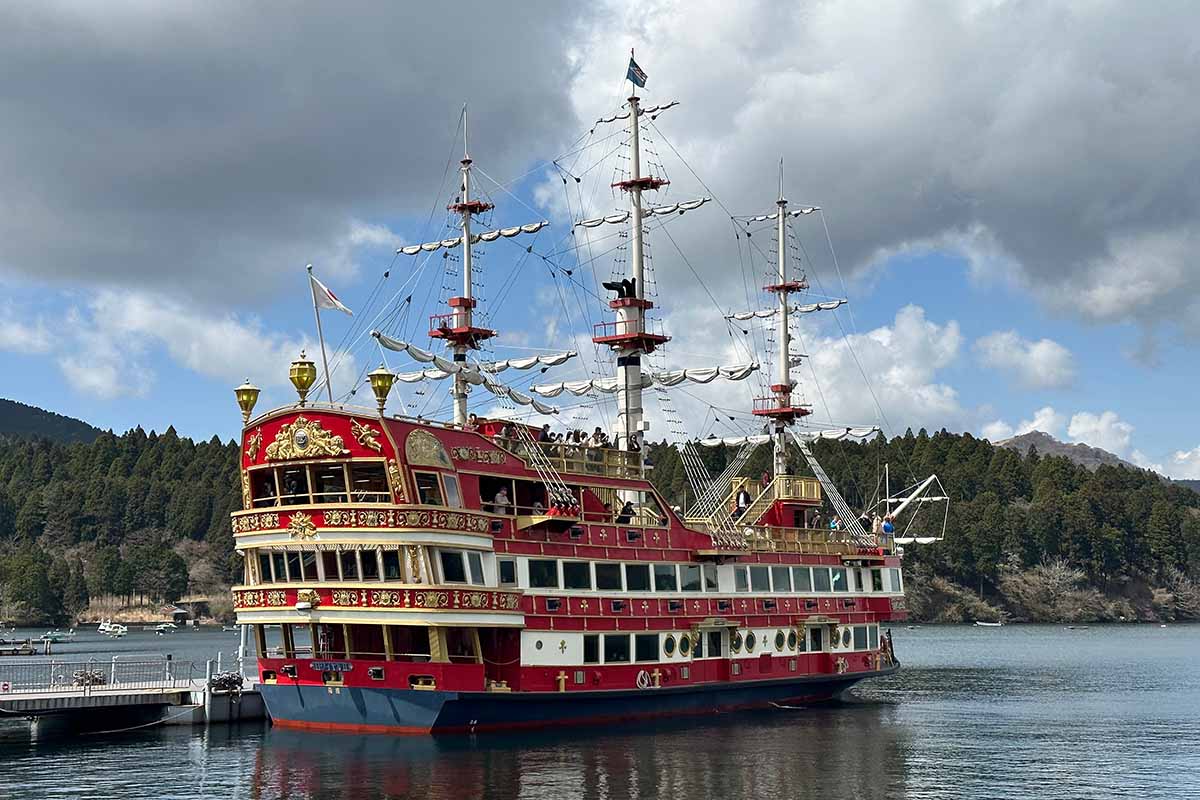
The scenic lake was created after the last eruption of Mount Fuji, over 3000 years ago. If you are lucky with the weather and have a clear day you can see Mount Fuji from the lake.
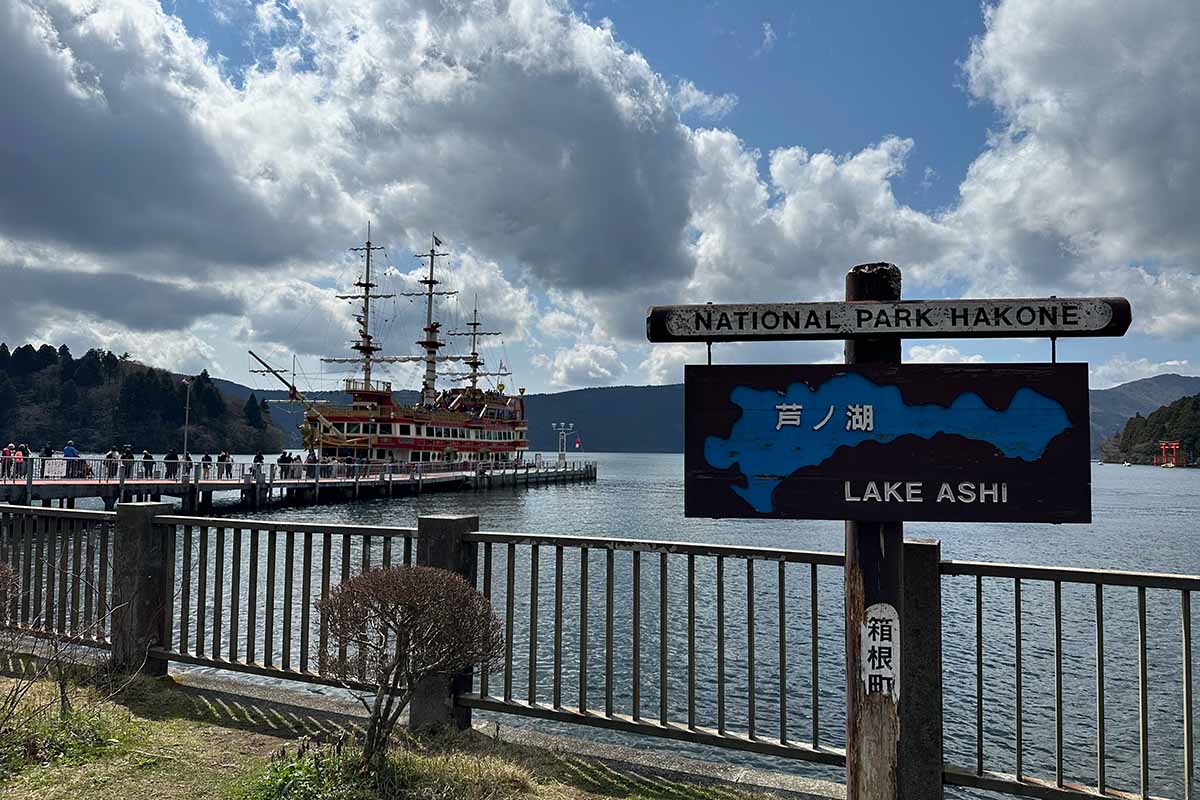
It takes around 25 minutes to cross the lake. On the other side we headed to a local shop to find out more about Japanese puzzle boxes.
These are boxes that can only be opened by a series of moves and manipulations. It was really fascinating hearing about the history of the boxes and how they are made.
There was no hard sell here though. They didn’t need to really, there were so many lovely things, it was hard to choose what to buy. I settled on a Kohsei doll and a puzzle box with 10 steps. Though since I’ve been home I’ve been too scared to open it in case I can’t do it!
And that was one of the easier ones. Some boxes have many more moves required until they open.
Leaving the shop, we headed to the Hakone Checkpoint. This site was a security checkpoint on the Tokaido highway which connected Kyoto to the capital, Edo (now known as Tokyo). Today it has been restored to its original state.
After heading through the checkpoint we took a short walk along Cedar Avenue, a path lined with cedar trees which is part of the old Tokaido highway.
By now, it was lunchtime so we had some free time to grab some food and have a wander.
On the shore of Lake Ashi hidden by trees is Hakone Shrine, a Shinto shrine dating back to 757. By the waterfront is Heiwa no Tori, a famous torii gate that appears to rise out of the water. It is another pretty popular Instagram spot so the line was long and plenty of photoshoots were going on.
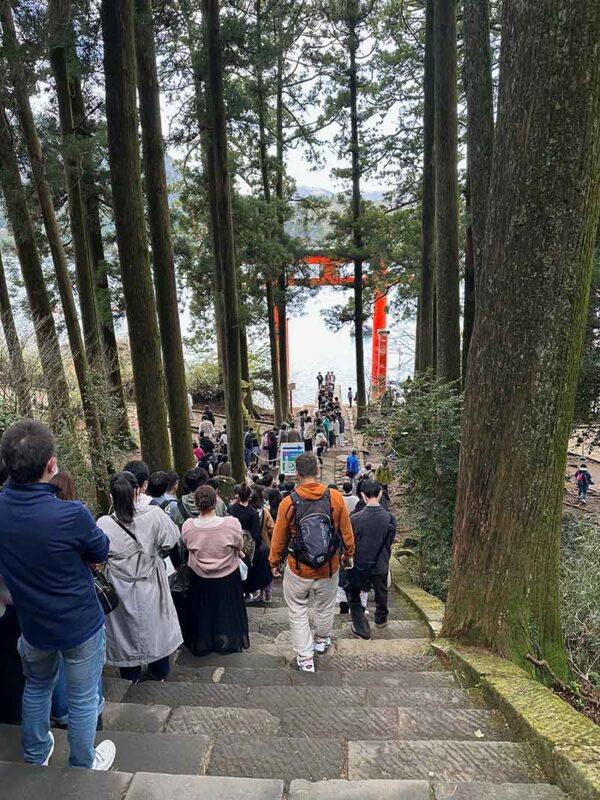
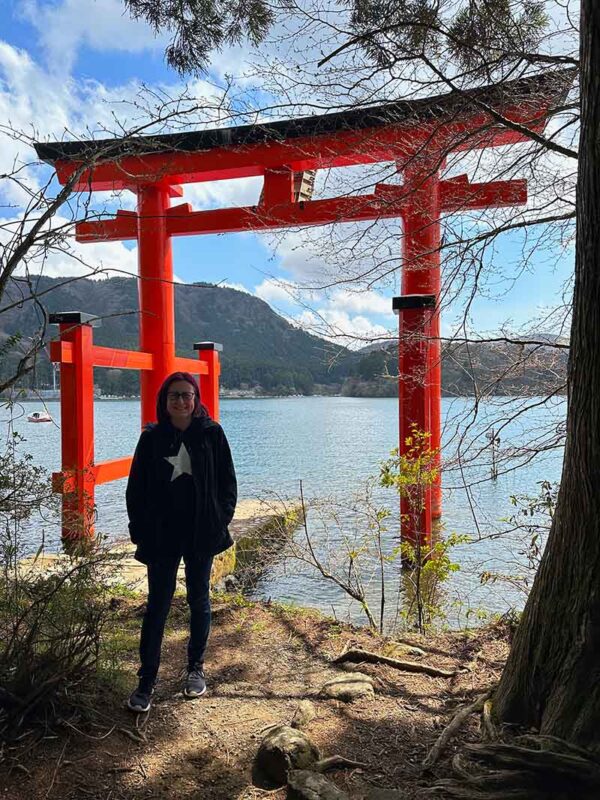
Tip | Head to the side of the torri gate if you don’t have time to queue. It might not be the money shot but it is still a good view. And a much shorter queue (if any).
All too soon it was time to head back across the lake. Once back on the ropeway, our luck was in as the clouds had mostly cleared and we had an amazing view of Mount Fuji.
Day 13 – Hakone to Tokyo
It seemed hard to believe, but it was time to head back to Tokyo. It felt both like yesterday and ages ago that we had left the capital city to explore more of Japan.
We took a limited express train and managed to catch one last glimpse of Mount Fuji, before arriving back in Tokyo.
This afternoon there was an optional tour of the Imperial Palace.
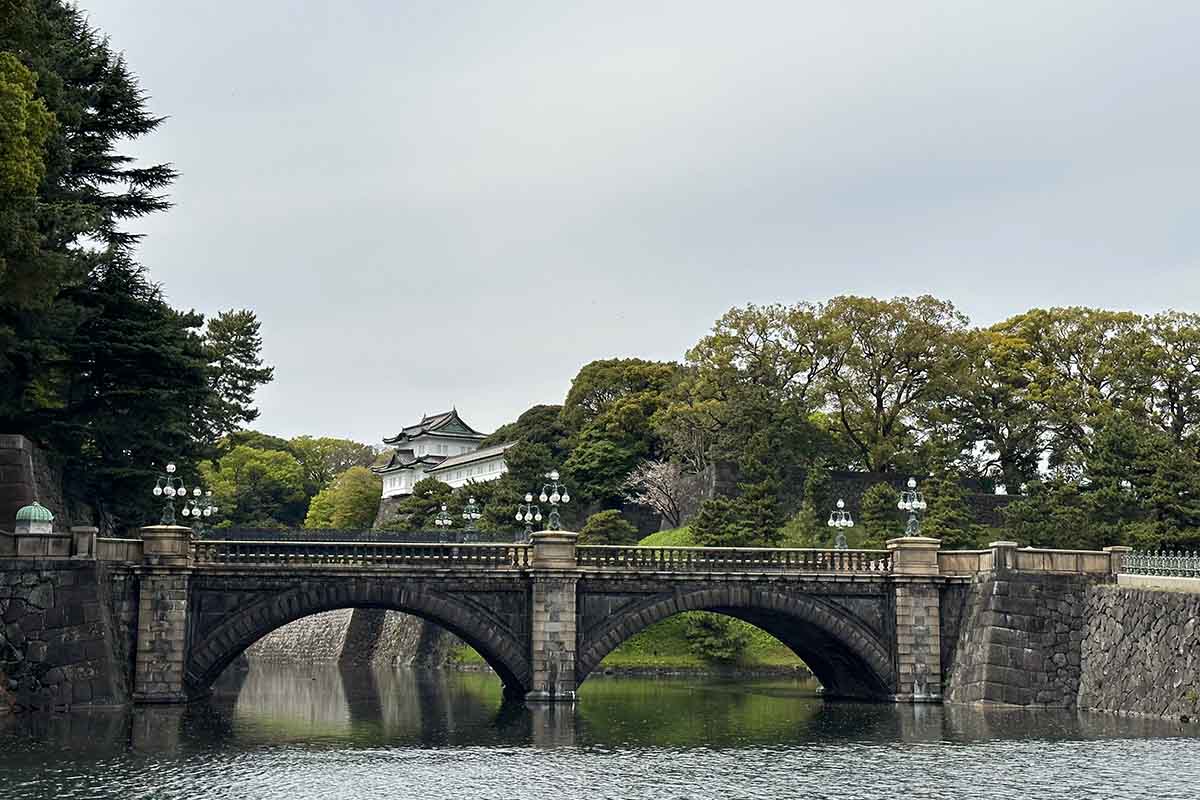
The gardens here are another popular viewing spot for both cherry blossoms and autumn leaves.
Inui Street, which runs through the gardens and is only accessible to the public for a few weeks each spring and autumn was open for the first time in four years. The wide street is lined by cherry blossoms and maple trees.
When we left Tokyo, the cherry blossom was just starting to bloom and as we returned it was beginning to wilt from the tree. It really brought home the transient nature of the blooms (and life)
Tonight’s farewell dinner was on Inside Japan. We had a private booth at a Izakaya. Similar to a tapas bar, small dishes of food was shared at the tables. It was a great way to spend our last evening as a group.
Before heading back to the hotel for one last night, we had a wander around the neon lights of Shinjuku and the maze of narrow alleyways of Omoide Yokocho.
Day 14 – End of the tour
The last day of the tour is where everyone goes their separate ways. So, it was lots of goodbyes in the breakfast room and reception as people headed home or off to explore more of Japan.
The Last Word
Since I’ve been home, a lot of my friends have asked if I would recommend a group tour. It’s not something most of them would consider. And to be honest I hadn’t really until this trip.
I’m now total convert and will definitely be looking at more group tours in the future.
Having all the logistics taken care of allows you to focus on the destination and as a solo traveller I really appreciated the company.
However, the real value was having the services of a guide. As well as sorting out all the admin throughout the trip, our guide really went above and beyond to make sure we had a great time and saw the best of Japan.
You may also like
- Should you visit Japan during cherry blossom season?
- What is it like to ride the Hello Kitty Shinkansen
- Is a cruise a good way to see Japan?